Peru and Parkinson’s Disease

According to the World Health Organisation 7 million people around the world have Parkinson’s disease. In Peru there are no official statistics but it is it is estimated that 30,000 people suffer with Parkinson’s and every year 2000-3000 new cases are found.

But from observation and comments of friends here, people hide disabilities or they can be undiagnosed so the numbers could be higher.

The treatment and lack of education about the disease is concerning.

Diagnosis of Parkinson’s disease in Peru is usually done by a neurologist but outside of the capital there are no Parkinson’s specialist neurologists (registered as Movement specialists)  and this can cause a variance of treatment. Unfortunately ‘Levodopa’ is prescribed from the beginning of the disease when it should be prescribed after about five years according to Doctor. Cesar Casteñada, Neurologo, Movement Disorders Specialist de Lima. The Parkinson’s medication “levodopa” has a shelf life and becomes less effective with time, and can even stop working after 5-10 years. Other drugs called Antagonists should be prescribed but they are expensive and may not be covered by health insurance in Peru (public or private).

Aside from drugs, the most important treatment that slows the diseases advancement is exercise but doctors here rarely mention this. One does not get a lot of time with the specialist and patient education is not a priority. It’s possible that doctors are not trained in what to recommend in terms of exercise therapy. Likewise referring people to a physiotherapist may lead to the same problem as in my experience in a regional city, physiotherapists lack training too.

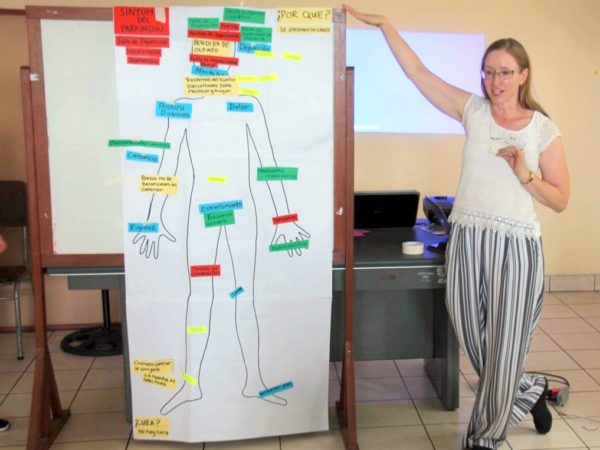
What is needed is an expansion of the education about Parkinson’s disease for patients, their families and the medical community. Recently I attended the Parkinson’s Association meeting in Lima and found it to be so beneficial for the people emotionally as we connected with others like us. We became more educated about the disease and the event finished with some physical therapy which encouraged people and informed them about what they could do to help prevent the disease getting worse. We all participated and had fun.

Let me give you one case study that shows the benefits of education and of Parkinson’s sufferers meeting together. Over the last 6 months I have been chatting on WhatsApp and by phone with a lady of about 49 years of age with severe Parkinson’s. I’ve encouraged her about doing exercise, sent her videos of simple things she could do and articles to read about benefits of exercise and how to have a positive attitude. I pray for her too but unfortunately she never said she did any of the exercises. She was encouraged by our friendship but was often depressed and didn’t want to go out. She wanted to meet me and go to the Parkinson association meeting so she came all the way to Lima from a city 12 hours away. She attended the meeting and I could see that the people around her encouraging her  and challenging her about some of the things that I have been saying for months. When she got home she found it hard because her symptoms were getting worse and the drugs weren’t working as well as they did before, but then she wrote me saying she was meeting someone else with Parkinson’s disease and she was realising the importance of exercise and they were doing it together. She realised with her diseases advancement she had to exercise and stretch as the drugs didn’t help much. Amazing progress.

She benefited from both the educational meeting of the Parkinson’s Association and uniting with other people who had the disease – this was a great encouragement to her.  This is needed across Peru.

PS- There are many more stories to tell and more stories and background can be found in previous blogs.

Articles in Spanish Media:

https://elperuano.pe/noticia-parkinsonconociendo-enfermedad-48861.aspx

https://peru21.pe/amp/lima/lima-habria-10-000-personas-parkinson-72412

https://alicia.concytec.gob.pe/vufind/Record/UPCH_2f01252d8dff0d77e52d8faa46f8b494

hLa Enfermedad de Parkinson’s en Peru

Según la Organización Mundial de la Salud, 7 millones de personas en todo el mundo tienen la enfermedad de Parkinson. En Perú no hay estadísticas oficiales, pero se estima que 30,000 personas sufren de Parkinson y cada año se detectan 2000-3000 casos nuevos.
Pero a partir de la observación y los comentarios de amigos aquí, las personas ocultan discapacidades o pueden ser no diagnosticadas para que las cifras sean más altas.

El tratamiento y la falta de educación sobre la enfermedad es preocupante.
El diagnóstico de la enfermedad de Parkinson en Perú generalmente lo realiza un neurólogo, pero fuera de la capital no hay neurólogos especialistas en Parkinson (registrados como especialistas en Movimiento) y esto puede causar una variación del tratamiento. Desafortunadamente, “Levodopa” se prescribe desde el principio de la enfermedad cuando debe recetarse después de unos cinco años, según el médico. Cesar Casteñada, Neurologo, Especialista en Trastornos del Movimiento de Lima. El medicamento “levodopa” de la enfermedad de Parkinson tiene una vida útil y se vuelve menos efectivo con el tiempo, e incluso puede dejar de funcionar después de 5-10 años. Se deben recetar otros medicamentos llamados Antagonistas, pero son caros y es posible que no estén cubiertos por el seguro de salud en Perú (público o privado).

Aparte de los medicamentos, el tratamiento más importante que retarda el avance de las enfermedades es el ejercicio, pero los médicos aquí rara vez lo mencionan. Uno no tiene mucho tiempo con el especialista y la educación del paciente no es una prioridad. Es posible que los médicos no estén capacitados sobre qué recomendar en términos de terapia de ejercicios. Del mismo modo, remitir a las personas a un fisioterapeuta puede llevar al mismo problema que en mi experiencia en una ciudad regional, los fisioterapeutas también necesiten capacitación.

Lo que se necesita es una expansión de la educación sobre la enfermedad de Parkinson para los pacientes, sus familias y la comunidad médica. Recientemente, asistí a la reunión de la Asociación de Parkinson en Lima y descubrí que era muy beneficioso para las personas emocionalmente, ya que nos conectamos con otros como nosotros. Nos educamos más acerca de la enfermedad y el evento terminó con una terapia física que alentó a las personas y les informó sobre lo que podían hacer para ayudar a prevenir que la enfermedad empeorara. Todos participamos y nos divertimos.

Permítame darle un estudio de caso que muestra los beneficios de la educación y la reunión de los pacientes de Parkinson. Durante los últimos 6 meses he estado hablando en WhatsApp y por teléfono con una mujer de unos 49 años de edad con Parkinson grave. La alenté a hacer ejercicio, le envié videos de cosas simples que podía hacer y artículos para leer sobre los beneficios del ejercicio y cómo tener una actitud positiva. Ore por ella también, pero desafortunadamente ella nunca dijo que hizo ninguno de los ejercicios. Nuestra amistad la animaba pero a menudo estaba deprimida y no quería salir.
Quería reunirse conmigo e ir a la reunión de la asociación de Parkinson, por lo que vino a Lima desde una ciudad a 12 horas de distancia. Ella asistió a la reunión y pude ver que las personas a su alrededor la alientan y la desafían por algunas de las cosas que he estado diciendo durante meses. Veía la muy atenta. Cuando llegó a casa, lo encontraba difícil porque sus síntomas empeoraron y las drogas no funcionaban tan bien como antes, pero luego me escribió diciendo que estaba con alguien más con la enfermedad de Parkinson y que se estaba dando cuenta de la importancia del ejercicio y lo hacían juntos. Se dio cuenta de que con el avance de sus enfermedades tenía que hacer ejercicio y estirarse ya que las drogas no ayudaban mucho. Increíble progreso.

Se benefició tanto de la reunión educativa de la Asociación de Parkinson como de la unión con otras personas que tenían la enfermedad, esto fue un gran estímulo para ella. Esto es necesario en todo el Perú.

PD: Hay muchas más historias que contar y más historias y antecedentes se pueden encontrar en blogs anteriores.

Artículos en medios españoles esten arriba.

Joy personified

This is more information about a Parkinson’s meeting I attended in Lima in January. That may seem boring to some but the next two characters certainly ensured it was not boring. Also see previous blog about the shocking misdiagnosis of a lady who attended.

Joy

One of the first persons to meet us was a vibrant lady in her early 50’s who had had the disease since she was 28 years old. Lets call her “Joy” as that she was, she immediately told us her story, including the trials of being called a drunk but most of all she was encouraging people “keep moving”, “don’t cry” , “do exercise” and “you can do it”.

She was quite the chatterbox but I could see my friend who’d taken a 12 hour bus to meet me at the meeting moved by her positive example. I enjoyed seeing her encouraged by someone else to do all the things I’d been encouraging her to do. It was nice I could remain silent and let Joy do what came naturally. Thank God for people like Joy who inspire us.

Movement Therapist

She was a pocket rocket – small but strong. From the get go she had us eating from her hand as she sang huskily along to the music and moved her hips and arms as only a latino can. She asked us all to join in (as we could) and ‘feel’ the music. This was the warm up and people who’d been in tears minutes earlier sang along and moved with enthusiasm. What a great way to warm up that anyone can do – limited movement or not. Music warms the soul and helps you move and smile. The exercise therapist then taught the group some basic stretching movements.

Everyone had a great time and I joked she needed to come to Arequipa every week (1.5 hours by plane). She does have a regular slot in Lima where older folk can go and the association can pass on the details.  

Again the positive outcomes of  having Parkinson’s association meetings are clearcut. We can encourage each other and exercise together and I am hoping we can replicate in our city.

Gozo Personificada

Esta es más información sobre una reunión de Parkinson a la que asistí en Lima en enero. Eso puede parecer aburrido para algunos, pero los siguientes dos personajes sin duda aseguraron que no fuera aburrido. También vea el blog anterior sobre el sorprendente diagnóstico erróneo de una señora que asistió.

Gozo
Una de las primeras personas que conocí fue una dama vibrante de unos 50 años que había contraído la enfermedad desde que tenía 28 años. Llamémosla “Alegría” como era, inmediatamente nos contó su historia, incluidas las pruebas de ser llamada borracha, pero sobre todo estaba animando a la gente a “seguir moviéndose”, “no llorar”, “hacer ejercicio”. Y usted puede hacerlo”.
Ella estaba bastante en el chatterbox pero pude ver a mi amiga que había tomado un autobús de 12 horas para reunirse conmigo en la reunión conmovida por su ejemplo positivo. Disfruté viéndola animada por alguien más para hacer todas las cosas por las que la había alentado. Fue agradable poder permanecer en silencio y dejar que Joy hiciera lo que era natural. Gracias a Dios por personas como Joy que nos inspiran.

Terapeuta de movimiento
Era un cohete de bolsillo, pequeña pero fuerte. Desde el principio, nos hizo comer de su mano mientras cantaba con la música y movía sus caderas y brazos como solo un latino puede. Nos pidió a todos que nos uniéramos (como pudiéramos) y “sintiéramos” la música. Este fue el calentamiento y las personas que habían estado llorando minutos antes cantaban y se movían con entusiasmo. Qué gran manera de calentar que cualquiera puede hacer, movimiento limitado o no. La música calienta el alma y te ayuda a moverse y sonreír. El terapeuta de ejercicios enseñó al grupo algunos movimientos básicos de estiramiento.
Todos la pasaron muy bien y yo bromeaba que ella necesitaba venir a Arequipa cada semana (1.5 horas en avión). Ella reside en Lima, donde la gente mayor puede ir y la asociación puede transmitir los detalles.

Nuevamente, los resultados positivos de tener reuniones de la asociación de Parkinson son claros. Podemos animarnos mutuamente y hacer ejercicio juntos, y espero que podamos replicar en nuestra ciudad.

Hiding Parkinson’s Disease and Disability in PERU

I’ve got a friend with Parkinson’s disease who feels alone. She doesn’t go out of her house unless she’s medicated and she has long off periods. She drags her feet when she walks and is embarrassed generally by the disease. She is self-conscious. Even her neighbours haven’t seen her walking. Why does she have such an attitude?

Peruvians tell me that there is prejudice against people with disability. They create a financial strain on their family and community. You don’t see many disabled on the streets except a few regular beggars. People hide away disabled family members. Children with disabilities are not exposed to normal outings and parents have low expectations of them which become self-fulfilling. One person was told not to touch an autistic children (as if it could be contagious). This is clearly unloving towards the child and exacerbates the disability further.

I created Facebook group for Parkinson’s Disease in my city with the idea of educating others about the disease and encouraging people to meet up to do exercise together. But people with Parkinson’s don’t want to come out. They may also be frightened of meeting someone new.

Why? It is a low trust society but also they could have mobility issues (taxi’s are expensive) or it might relate to other people’s attitude to them. Often disability in the family leads to people believing it is somehow the fault of the family. Maybe it is the fault of the parents or discipline from God. There is also a lot of superstition so they look for something or someone to blame.

If they go to church they sometimes get told to pray for healing and have faith more God. And if no healing happens they don’t want to go to church anymore. Worse still, one friend said they’ll go from religion to religion or to the witch doctor to a quack doctor looking for something that helps but never committing to any religion fully – he called it religion shopping.

So when people find out ‘the missionary’ has a disease they are shocked and tell me what they have been told “I need to pray and have faith”. Paul had huge faith and God didn’t heal him and there are people throughout the Bible who suffered: Daniel, Joseph, Naomi, Hannah. And Job was tested because of his good faith which messes with that idea a bit too. I am not suggesting I am like Job or Paul but I also sense that unspoken question ‘’what sin in your life is preventing your healing’.  I’ll be the first to admit that I fail and sin more often than I’d like to admit openly but I believe God to be a gracious and loving God. He sees our hearts. If Jesus has died on the cross for my sin, I don’t think he will punish me (with a disease) unless it is a direct consequence of bad choices, ie smoking can lead to lung cancer.

In the Bible there is a story about a blind man (John, 9:1–12) and Jesus’ disciples asked:

“Rabbi, who sinned, this man or his parents, that he was born blind?”

“Neither this man nor his parents sinned,” said Jesus, “but this happened so that the works of God might be displayed in him. As long as it is day, we must do the works of him who sent me”.

Jesus healed the blind man and displayed his power.  Maybe God wants to demonstrate his power in me or others but it isn’t always clear God’s purpose in everything.

In the Bible we also see Jesus was forgiving: When a lady was condemned for adultery and the Jews wanted to stone her, What was Jesus response?

“Let any one of you who is without sin be the first to throw a stone at her.”

Meanwhile Jesus wrote something on the ground. If you feel judged by others remember Jesus asked her “who condemns you” to the lady. She said “Noone! Jesus responds -“Then neither do I condemn you, Go now and leave your life of sin.” We should always be striving to leave sin behind whatever health problems come our way. Our health problems are not a curse from God for past actions.

I don’t and can’t hide my disability and any questions or comments help educate one more person, one person at a time. I can’t sit home and hide – I have responsibilities and children and there are beautiful places to see and mountains to get to the top of. This picture is from Rainbow mountain, an amazingly beautiful place in Peru we went to this week.

I got a horse some of the way up. I climbed the last 300 metres at an altitude of 5000 metres and I helped my hesitant 9 year old niece to keep going. I walked all the way down. I am looking for the next challenge…. to raise funds for Parkinson’s disease and my trip to World Parkinson’s congress. Ideas welcome.

I won’t stop living and enjoying life, even if I have fear. Hopefully you can live this way too.

Ps. This is a big theological topic so I am not able to do it justice.

Further reading:

https://www.desiringgod.org/messages/why-was-this-child-born-blind\

Prejuicio contra personas con discapacidad en el Perú.

Tengo una amiga con la enfermedad de Parkinson que se siente sola. Ella no sale de su casa a menos que esté medicada y tenga periodos prolongados. Ella arrastra los pies cuando camina y, en general, se siente avergonzada por la enfermedad. Ella es consciente de sí misma. Incluso sus vecinos no la han visto caminar. ¿Por qué tiene esa actitud?

Los peruanos me dicen que hay prejuicios contra las personas con discapacidad. No ves muchos discapacitados en las calles, excepto unos pocos mendigos regulares. La gente esconde a sus familiares discapacitados. Los niños con discapacidades no están expuestos a salidas normales y los padres tienen bajas expectativas de ellos, que se vuelven autosuficientes. A una persona se le dijo que no tocara a un niño autista (como si pudiera ser contagioso). Esto es claramente poco amoroso hacia el niño y exacerba aún más la discapacidad.
Creé el grupo de Facebook para la enfermedad de Parkinson en mi ciudad con la idea de educar a otros sobre la enfermedad y alentar a las personas a reunirse para hacer ejercicio juntos. Pero las personas con Parkinson no quieren salir. Drepente pueden tener miedo de conocer a alguien nuevo.

¿Por qué? Es una sociedad de baja confianza, pero también podrían tener problemas de movilidad (los taxis son caros) o podrían estar relacionados con la actitud de los demás. A menudo, la discapacidad en la familia lleva a las personas a creer que de alguna manera es culpa de la familia. Tal vez sea culpa de los padres o disciplina de Dios. También hay mucha superstición por lo que buscan algo o alguien a quien culpar.

Si van a la iglesia, a veces se les dice que oren por sanidad y tengan más fe en Dios. Y si no hay curación, ya no quieren ir a la iglesia. Peor aún, un amigo le dijo que irán de religión en religión o de brujo a médico curandero en busca de algo que ayude, pero que nunca se comprometa con ninguna religión por completo, él lo llamó ir de compras a la religión.

Entonces, cuando la gente descubre que “el misionero” tiene una enfermedad, se escandalizan y me dicen lo que me han dicho “Necesito orar y tener fe”. Pablo tenía una gran fe y Dios no lo sanó y hay personas en toda la Biblia que sufrieron: Daniel, José, Noemí, Ana. Y Job fue probado debido a su buena fe, que también confunde un poco con esa idea. No estoy sugiriendo que soy como Job o Pablo, pero también siento que la pregunta no formulada “qué pecado en tu vida está impidiendo tu curación?” Seré la primera en admitir que fracasó y peco más a menudo de lo que me gustaría admitir abiertamente, pero creo que Dios es un Dios bondadoso y amoroso. Él ve nuestros corazones. Si Jesús murió en la cruz por mi pecado, no creo que me castigue (con una enfermedad) a menos que sea una consecuencia directa de malas decisiones, es decir, fumar puede provocar cáncer de pulmón.
En la Biblia hay una historia sobre un hombre ciego (Juan, 9: 1–12) y los discípulos de Jesús preguntaron:
“Rabino, ¿quién pecó, este hombre o sus padres, que nació ciego?”

“Ni este hombre ni sus padres pecaron”, dijo Jesús, “pero esto sucedió para que las obras de Dios se mostrarán en él. Mientras sea día, debemos hacer las obras del que me envió “.

Jesús sanó al ciego y mostró su poder. Tal vez Dios quiere demostrar su poder en mí o en otros, pero no siempre es claro el propósito de Dios en todo.

En la Biblia también vemos que Jesús perdonaba: cuando una mujer fue condenada por adulterio y los judíos querían apedrearla, ¿cuál fue la respuesta de Jesús?
“Que cualquiera de ustedes que este sin pecado sea el primero en tirarle una piedra”. Mientras tanto, Jesús escribió algo en el suelo. Si te sientes juzgado por otros, recuerda que Jesús le preguntó a ella “quién te condena”. Ella dice que ninguno y Jesús responde: “Entonces tampoco te condeno, vete ahora y abandona tu vida de pecado”. Siempre debemos esforzarnos por dejar el pecado detrás de cualquier problema de salud que se nos presente. Nuestros problemas de salud no son una maldición de Dios por las acciones pasadas.

No puedo y no puedo ocultar mi discapacidad y cualquier pregunta o comentario ayuda a educar a una persona más, una persona a la vez. No puedo sentarme en casa y esconderme, tengo responsabilidades y niños, y hay hermosos lugares para ver y montañas para llegar a la cima. Esta imagen es de Rainbow mountain, un lugar increíblemente hermoso en Perú al que fuimos esta semana.

Tuve un caballo en el camino. Subí los últimos 300 metros a una altura de 5000 metros y también ayudé a mi temerosa sobrina de 9 años. Bajé todo el camino hacia abajo para que no fuera del todo fácil. Estoy buscando el próximo reto…. para recaudar fondos para la enfermedad de Parkinson y mi viaje al congreso World Parkinson. Ideas bienvenidas.

No puedo dejar de vivir y disfrutar la vida, aun tengo miedo a veces. Espero que tu puedes vivir igual amigos.

PD. Este es un gran tema teológico, así que no puedo hacerle justicia.

Otras lecturas:

https://www.desiringgod.org/messages/why-was-this-child-born-blind


This is the track to top where the dip is in the centre of the picture

Iguazu Trip – Amazing

I had the privilege of attending a special retreat earlier this year in Iguazu. I had wanted to go to Iguazu Falls ever since I saw pictures of it.

I usually don’t really like bucket lists, but I really wanted to go there. David had already been and so I had been hoping for the opportunity to go without him for quite a while and in June that opportunity arose. Even better – I was able to use frequent flyer points to fly there, making the deal too good to miss.

It was a special conference (invitation only) with free accommodation including 2 meals a day. It was a time to relax and take stock of life. There was Christian worship and a sermon daily plus some other special services like a free haircut, lovely pools to swim in and even a 10-pin bowling alley where I surprised my competitors. I achieved 2 strikes plus 2 spares and generally high scores! Do not ever underestimate a Parkinson’s patient in bowling – I beat everyone by a long way – I even surprised myself!

It was the visit to The Falls however, that truly impressed me. The falls has two sides to it – the Argentinian side and the Brazil Side (the Argentinian side had better wheelchair access!)

The Argentinian side was big and took us most of the day to explore. I am not used to walking around ALL day but it was amazing. I was completely exhausted by the day’s end, but in awe of God’s wonderful creation.

The Brazil side had more steps but was a ‘before lunch’ half day visit and also awe-inspiring.

I thoroughly recommend spending two full days in Iguazu – if you ever have the opportunity to go there. You will not be disappointed.

At the falls, there lays a plaque that says:

Mightier than the thunder of the great waters,

mightier than the breakers of the sea—

the Lord on high is mighty” Psalms 93:4

I cannot use adequate words to describe the falls, except to say that it is a series of falls (275 to be exact) spread over 2.7 kilometres – you can imagine the noise and the distance it covers.

And the Lord is stronger than this – stronger than Iguazu! The plaque then continues to say …”God is always greater than all our troubles”. What a great reminder!

Photos really cannot do it justice, but I will add some below for you to look at. A picture speaks a thousand words, as the saying goes.

As for the rest of the conference – I will be sure to write more about that in another blog!

Viaje a Iguazú – Increible

Tuve el privilegio de asistir a un retiro especial en Junio de este año en Iguazú. Quería ir a las Cataratas del Iguazú desde que vi fotos de ella.

Por lo general, no me gustan las listas de deseos (bucket lists), pero realmente quería ir allí. David ya había estado y, por lo tanto, había esperado la oportunidad de quedarme sin él durante bastante tiempo y en junio surgió la oportunidad. Aún mejor: pude usar los puntos de viajero frecuente para volar allí, haciendo que el trato fuera demasiado bueno para fallar. 

Fue una conferencia especial (solo con invitación) con alojamiento gratuito que incluye 2 comidas al día. Era un momento para relajarse y hacer un balance de la vida. Hubo un culto cristiano y un sermón todos los días, además de algunos otros servicios especiales, como un corte de cabello gratis, hermosas piscinas para nadar e incluso una bolera de 10 pines donde sorprendí a mis competidores. Logré 2 strikes más 2 repuestos y en general altas puntuaciones! No subestimes nunca a un paciente de Parkinson en los bolos: les gané a todos por un largo camino, ¡incluso me sorprendí a mí mismo! 

Sin embargo, fue la visita a The Falls lo que realmente me impresionó. Las cataratas tienen dos caras: la Argentina y la Brasileña (¡la Argentina tenía mejor acceso para sillas de ruedas!) 

El lado Argentino era grande y nos llevó la mayor parte del día para explorar. No estoy acostumbrado a caminar todo el día pero fue increíble. Estaba completamente agotado al final del día, pero admirando la maravillosa creación de Dios. 

El lado de Brasil tenía más pasos, pero era una visita de medio día “antes del almuerzo” y también impresionante. 

Recomiendo pasar dos días completos en Iguazú, si alguna vez tienes la oportunidad de ir allí. Usted no será decepcionado. 


En las cataratas, hay una placa que dice:                                                         “Más poderoso que el trueno de las grandes aguas, 
más poderosos que los rompientes del mar— 
el Señor en lo alto es poderoso” Salmos 93: 4 

No puedo usar las palabras adecuadas para describir las caídas, excepto para decir que se trata de una serie de caídas (275 para ser exactos) que se extienden a lo largo de 2,7 kilómetros: se puede imaginar el ruido y la distancia que cubre. 

¡Y el Señor es más fuerte que esto, más fuerte que Iguazú! La placa continúa diciendo … ” Dios siempre es más grande que todos nuestros problemas”.  ¡Qué gran recordatorio! 

Las fotos realmente no pueden hacerle justicia, pero agregaré algunas a continuación para que las veas. Una imagen vale más que mil palabras, como dice el dicho. 

En cuanto al resto de la conferencia, ¡me aseguraré de escribir más sobre eso en otro blog!

Special Diet for Parkinson’s?

Eating Out Anniversary

People frequently ask me about Diet and parkinson’s disease. There is no magical diet to help parkinson’s.  There is lots written about this but more scientific studies are needed and ideas not widely tested yet. This is an overview only.  These following points summarise the concepts about diet I have learnt through reading and visiting professionals.

(SINCE WRITING IT HAS COME OUT THE MEDITERRANEAN DIET COULD BE HELPFUL – JULY 2020)

  1. We all should eat a balanced diet, fruit, vegetables, fish and whole grains.
  2. That although some foods are higher in dopamine you’d need to eat them by the bucket load to make a difference
  3. Many parkinson’s patients suffer from constipation so need to have a high fibre diet to help move the bowels
  4. Others have medication that makes them lose weight (not I)
  5. Others have physical problems that make cooking/ preparing food hard or have problems swallowing.

A nutritionist has evaluated my diet and was happy with what I ate. Thankfully I am not affected by the problems mentioned above.

¿Dieta Especial de Parkinson’s?

La gente me pregunta frecuentemente sobre la dieta y la enfermedad de Parkinson. No hay una dieta mágica para ayudar a la enfermedad de Parkinson. Hay mucho escrito sobre esto, pero se necesitan más estudios científicos y las ideas aún no están ampliamente probadas. Hay mucho escrito sobre este tema, este es solo un breve resumen. 😉

Los siguientes puntos resumen los conceptos sobre la dieta que he aprendido a través de la lectura y la visita de profesionales.

  1. Todos debemos comer una dieta equilibrada, frutas, verduras, pescado y cereales integrales.
  2. Que a pesar de que algunos alimentos son más altos en dopamina, deberías comerlos por la carga del cubo para hacer una diferencia.
  3. Muchos pacientes de Parkinson sufren de estreñimiento, por lo que deben llevar una dieta rica en fibra para ayudarle ir al baño.
  4. Otros tienen medicamentos que les hacen perder peso (no yo)
  5. Otros tienen problemas físicos que dificultan la cocción / preparación de alimentos o problemas para tragar.

Un nutricionista ha evaluado por la dieta y se mostró feliz con él porque está equilibrado. Afortunadamente no estoy afectado por estos problemas mencionados.

The Intervention

The Intervention
You are seated with friends and family then suddenly it begins.
The intervention*: ”You are NOT looking after yourself and your health”. You are a deer in the spotlight. Awkward silence. Your face is red. “It is just so hard” you mumble. What is this? You think to yourself “But I am not an alcoholic.”
They say: “You have a problem! You need to accept it and deal with it.”
You keep your eyes on the floor but deep down you know they are correct. But you are defensive. You look at each one thinking about what you could say back but you know that won’t help.
Your family wants to check you into a clinic to adjust, get sober, calibrate, be re- educated, trained and prepared to return to the real world with all its temptations, distractions and stresses.

Two friends together asked me how I was doing (re PD) so that led me to think of this scenario. It wasn’t anything like an intervention. But then I imagined my friends and family doing an intervention on me like you would to an alcoholic. I had been struggling with consistency in my Parkinson’s Disease exercises. Everyone needs to know or should know that the only way to prevent the disease getting worse is to exercise, so I need to be disciplined. It will always be a challenge.

Talking about my health is public domain. I have made it that way but sometimes the cheeky side of me wants to say let’s talk about you:
“If you were subject to an intervention — what would it be about? Health, bad habits, emotional issues, eating or exercise …. Fill in the blank. Would you welcome the intervention? Would you want to make changes?
We all have problems we need to deal with and we all go through ups and downs in looking after ourselves. I would suggest you get help (professional or other support) or an accountability partner or system. This helps me. I hope someone close to you is willing to help you but hopefully it doesn’t need to be an intervention.

PS. I would like to go to such a Parkinson’s Disease clinic in the near future though it won’t be like drug or alcohol rehabilitation I am sure I will come away re-trained and ready to fight Parkinson’s Disease in a better way.

*An intervention is an orchestrated attempt by one or many people – usually family and friends – to get someone to seek professional help with an addiction or some kind of traumatic event or crisis, or other serious problem (wikipedia).

La intervención

Estás sentado con amigos y familiares, entonces de pronto comienza.

La intervención: “No estás cuidando a ti mismo y a tu salud”. Eres un ciervo en el centro de atención. Silencio incómodo. Tu cara es roja. “Es tan difícil” murmuras. ¿Qué es esto? Piensas para ti mismo “Pero no soy un alcohólico”.

Dicen: “¡Tienes un problema! Necesitas aceptarlo y lidiar con eso ”.

Mantienes tus ojos en el piso, pero en el fondo sabes que son correctos. Pero usted está a la defensiva. Mire a cada uno pensando en lo que podría decir, pero sabe que eso no ayudará.

Su familia quiere inscribirlo en una clínica para adaptarse, mantenerse sobrio, calibrar, ser reeducado, capacitado y preparado para regresar al mundo real con todas sus tentaciones, distracciones y estrés.

Dos amigos me preguntaron cómo estaba (re PD), lo que me llevó a pensar en este escenario. No era nada como una intervención. Pero luego me imaginé a mis amigos y familiares haciéndome una intervención como lo harías con un alcohólico. Había estado luchando con la consistencia en mis ejercicios para la enfermedad de Parkinson. Todos necesitan saber o deberían saber que la única forma de evitar que la enfermedad empeore es hacer ejercicio, por lo que debo ser disciplinado. Siempre será un reto.

Hablar de mi salud es de dominio público. Lo he hecho de esa manera, pero a veces mi lado descarado quiere decir, hablemos de ti:

“Si estuvieras sujeto a una intervención, ¿de qué trataría? Salud, malos hábitos, problemas emocionales, comer o hacer ejercicio…. Rellena el espacio en blanco. ¿Te gustaría recibir la intervención? ¿Te gustaría hacer cambios?

Todos tenemos problemas con los que tenemos que lidiar y todos pasamos por altibajos cuidando de nosotros mismos. Le sugiero que obtenga ayuda (profesional o de otro tipo) o un socio o sistema de responsabilidad. Esto me ayuda Espero que alguien cercano a usted esté dispuesto a ayudarlo, pero espero que no tenga que ser una intervención.

  1. Me gustaría ir a una clínica de este tipo para la enfermedad de Parkinson en un futuro cercano, aunque no será como la rehabilitación de drogas o alcohol, estoy seguro de que volveré entrenado y listo para combatir la enfermedad de Parkinson de una mejor manera.

* Una intervención es un intento orquestado por una o muchas personas, generalmente familiares y amigos, para lograr que alguien busque ayuda profesional con una adicción o algún tipo de evento traumático o crisis, u otro problema grave (wikipedia).

Some days…

Some days I sense the urgency, other days I want to stay in bed

Some days I am full energy, other days not

Some days I am strong, other days I struggle with one chin-up

Some days I am happy, other days cranky

Some days I go to the gym, other days I don’t.

Some days I am extroverted, other days I want be alone

Some days I am patient with homework, other days I want to give up.

Some days I wish I was a better parent, other days I realise so do most

Some days I pray for healing, other days I accept my situation

Some days I want to do amazing things, other days I remember ‘I have too much on’

Some days I kiss my children goodnight, other days they tuck me in

Some days I feel depressed but most days I am super grateful

Everyday I have Parkinson’s Disease and everyday I need to take drugs

Every day I struggle to walk when my drugs wear off

Everyday I need to be determined, Everyday I need to be strong

Everyday I need to ignore the apathy and push on

Everyday day I make mistakes but then I am guessing so do you.

Everyday I am grateful for husband who sees the positives in me

Everyday I trust God to use me: the good, the bad and ugly

Everyday for better or worse Parkinson’s inspires me…


A friend asked me how my personality has changed – this is my response.

Algunos dias…
Algunos días estoy llena de energía, otros días no
Algunos días estoy feliz, otros días renegona.
Algunos días beso a mis hijos buenas noches, otros días me acostarme temprano
Algunos días soy paciente con la tarea, otros días también quiero rendirme.
Algunos días desearía ser un mejor padre, otros días me doy cuenta de que otras padres sienten igual
Algunos días soy extrovertida, otros días quiero estar sola
Algunos días voy al gimnasio, otros días no.
Algunos días soy fuerte, otros días no puedo hacer mucho
Algunos días ruego por sanarme, otros días aceptó mi vida como es
Algunos días quiero hacer cosas impresionante / dejar un legado, otros días recuerdo que “tengo demasiado para hacer ya”
Algunos días siento la urgencia, otros días quiero quedarme en la cama
Algunos días quiero viajar por todo el mundo, otros días soy realista.
Algunos días me siento deprimida pero la mayoría de los días estoy súper agradecido

Todos los días tengo la enfermedad de Parkinson y todos los días necesito tomar medicamentos
Todos los días necesito ser determinado, Todos los días necesito ser fuerte
Todos los días necesito ignorar la apatía y seguir adelante.
Todos los días lucho por hacer cosas que deberían ser fáciles.
Todos los días estoy agradecido por el marido que ve lo positivo en mí.
Todos los días cometo errores, pero luego pienso que supongo que tú también.
Todos los días confío en que Dios me usarme: lo bueno, lo malo y lo feo.
Todos los días, para bien o para mal, el Parkinson me inspira …

Un amigo me preguntó cómo ha cambiado mi personalidad, esta es mi respuesta.

It’s important the act you follow

It is common to have people get on the local buses to sell sweets or biscuits (or perform musically) to get a meagre income but the sales pitch often comes with a story. I was on the bus with Annabelle and there was a salesman selling his booklet of psychological tips. He kind of sounded like a preacher so with nothing to do we listened in. After his spiel he offered a free book to whoever could answer his question. I gave it a try, wrong. Annabelle tried, another tried and then finally the young man next to us tried but he too was rejected. The young man said he’d heard the man before and he changed the answer every time. The man went on and on despite no sales of his booklet. He asked what was the cause of problems in the world. I said ‘sin’. He said no in a long-winded way. Then he asked “how do we find the truth?” I said “In the Bible” but my pre teen was getting embarrassed by my involvement so I went quiet while he went on about the good in the Bible, rich pastors, then that the expectation of 10% as offering to the church, and that it was not in the Bible. I held my tongue as he wasn’t listening. Finally he got off the bus with not one sale.

A few minutes later a very old man stood up and explained he’d come to Arequipa to help his daughter and her children who’d been abandoned by her husband and worse still she had cancer. He held his bag of sweets ready to sell.

But then he said “ I am from a highland village where I help a Pastor an Evangelical church and that man was wrong about giving 10%, it is in the Bible. I don’t like those mega churches that demand money either but in our church we decide how to use the money to help the church”. He said more but by this point people were already getting coins out to donate, few actually took a sweet because they knew he was for real. He probably never received so much. I’m guessing the incredible response was because of the salesman that he followed. It does matter the act you follow.

Importa mucho la acción y la persona que sigue.

Es común aquí ver vendedores subir a las combis (o buses) para vender dulces o galletas (o tocar música) para obtener algunos ingresos; pero el argumento de venta a menudo incluye una historia. Estaba en el autobús con Annabelle y había un vendedor que vendía su folleto de consejos psicológicos. Sonaba como un predicador, así que sin nada que hacer, escuchamos. Después de su discurso, ofreció un libro gratis a quien pudiera responder su pregunta. Cuando intenté responder, me equivoque. Annabelle lo intentó una vez, luego  otra vez y, finalmente, lo intentó un joven que estaba sentado a nuestro lado, pero él también tenía la respuesta incorrecta. El joven dijo que ya había escuchado al hombre antes y siempre cambiaba la respuesta. El hombre siguió y siguió a pesar de no haber vendido su folleto. Luego, preguntó sobre cuál era la causa de los problemas en el mundo. Yo le dije “el pecado”. A lo que me respondió “no” de una manera prolongada. Luego preguntó: “¿Cómo encontramos la verdad?”. Le dije “En la Biblia”, pero mi pre adolescente se estaba avergonzando por mi participación, así que me quedé callada mientras él hablaba sobre lo bueno en la Biblia, los pastores ricos, y que esperaban del 10% como ofrenda a la iglesia, y que eso no estaba en la Biblia. Me mantuve callada ya que él no me estaba escuchando. Finalmente, se bajó del autobús sin una sola venta.

Unos minutos más tarde, un hombre ya mayor se levantó y le explicó que había llegado a Arequipa para ayudar a su hija y sus hijos que habían sido abandonados por su marido y, peor aún, que tenía su hija tenía cáncer. Sostuvo su bolsa de dulces lista para vender.

Pero luego dijo: “Soy de un pueblo en las alturas en donde ayudo a un pastor en una iglesia evangélica y que ese hombre está equivocado con respecto a dar el 10% a la iglesia, eso está en la Biblia. Tampoco me gustan esas mega iglesias que demandan dinero, pero en nuestra iglesia decidimos cómo usar el dinero para ayudar a la iglesia ”. Dijo más, pero la gente ya estaba alistando sus monedas para donarle, pocas personas tomaron algunos dulces porque sabían que su historia era real. Probablemente nunca recibió tanto. Supongo que la increíble respuesta fue porque él fue el que siguió al anterior. En sí, importa mucho la acción y la persona que sigue.


6 attempts to get Driver License in Peru

Only tiny cars fit on the course. Waiting cars

Getting my Peruvian Drivers License has been one of the most challenging experiences of my life. Every time I have attempted the test I did ‘new things wrong’, some of which had me thrown out of the test area immediately. You are probably imagining car crashes, terrible parallel parks or hitting cones (common error). People wonder if Parkinson’s affects my driving – it doesn’t. 

Nope, my faults were: touching the white line at a zebra crossing, having my bumper a millimeter over a line, stopping in a curve which wasn’t a curve, forgetting to indicate, stalling when the evaluator criticised me mid turn and others that are harder to explain.

The test course

I started to get flustered easily and do more things ‘wrong’, never completing the test. My parkinson’s tremble got worse when I usually control it well. The perfectionism required was unfathomable considering how many people actually drive here.

As a Christian my faith affects my life and though not everyone agrees we can respect each others experience. I was angry and distressed but God brought me this beautiful Psalm to give me perspective.

Commit everything you do to the Lord. Trust him, and he will help you. He will make your innocence radiate like the dawn, and the justice of your cause will shine like the noonday sun.

Be still in the presence of the Lord, and wait patiently for him to act. Don’t worry about evil people who prosper or fret about their wicked schemes.

Stop being angry! Turn from your rage! Do not lose your temper— it only leads to harm. For the wicked will be destroyed, but those who trust in the Lord will possess the land.  Psalms 37: 6-9

Despite everyone’s prayers I wasn’t getting my license. I started to think of my Peruvian friends and how they encouraged me to bribe. One friend had written to me earlier saying to bribe was the only way but when she read these verses and saw my resolve, she wrote “I admire your courage and braveness to not succumb to corruption. Hopefully what you are doing helps the system change”.

Sadly I don’t think that happened but God did want to go through this and have empathy? If I didn’t struggle and fail I’d not be so determined to see change for my Peruvian friends. Plus the truth is that I could get my Australian license validated in Peru if I got desperate. It’s expensive and it involves complicated paperwork but it is possible. Peruvian don’t have any options so by completing the process to I was ‘ walking a mile in their shoes’ and I feel their pain they face. I cried tears of anguish for me but really deeper down for those who struggle to pass the test, for those who want to do the right thing.

That led me to a similar biblical phrase…though different; “If anyone forces you to go one mile, go with them two miles”.

Yes, that is me I thought. Very different to choosing to walk a mile in someone’s shoes. Forced to do it. (although I was choosing to get my licence).  The passage continues;  “You have heard that it was said, ‘Love your neighbor[i] and hate your enemy.’ But I tell you, love your enemies and pray for those who persecute you, that you may be children of your Father in heaven. Be perfect, therefore, as your heavenly Father is perfect”. Matthew 5:41, 43-45, 48.

No small order indeed. I asked God for lots of help on this one. I made friends with the guards and tried to be nice to everyone. Still no success.

A new friend in the test kindly said that these evaluators would help me through the test if I just paid for ‘help’. They had coached her to pass.

Finally, David said yesterday “Don’t go anymore”. He could see how stressed I was under the pressure of evaluators who were waiting for me to finally pay the bribe. I had one last test booked so I went to the licence boss, who I had already met several times as I queried the process. I presented her a letter of complaint, which I read aloud through tears, plus the conditions on which I would do the test. She listened to my requirements:  That noone yell at me or accused me mid test and I asked her came to supervise.

Well, I think it was me crying publicly that finally got to her and a desire to get rid of me because I passed. Praise God. Another test participant noted “they are not yelling today” when we’d completed it.

Pray for safe travel on the roads and wisdom for Peruvians dealing with corruption daily. Sadly I am told this normal across the the bureaucracy ;-(

Written February 2018

To read the update go to Radio Robbery -Driving-in-Peru-update in June 2020:

School Pick-up with Parkinson’s Disease


You know everyone is looking at you already; I am the only blond at school pick up in a sea of shades of black and brown hair. I focus intently on attempting to “walk normally”. My left knee won’t lift, it drags my left foot on the ground. I force it up and succeed for about 3 steps but it makes a sound as it hits the pavement every time. People look around without even realising what they’re doing. Kids stare. I smile at parents and greet folk who meet my eyes, pretending nothing is wrong. I refocus, lift left leg, place foot down carefully to avoid the sound but the next step it sounds again, as I loose concentration and momentum as a toddler darts across my pathway. My thoughts flick to how a disability is thought to be a curse here. Oh the horror. I refocus again and I start to jog the few remaining steps to the gate. It is easier than walking. I see my kids, kiss their sweet faces and walk back to the car carrying an oversized backpack but focused on ‘their days’ and not on me or how I walk. 

Recogiendo niños , Madre con Parkinsons.

Sabes que todos ya te están mirando; Soy la único rubia en el colegio en un mar de sombras de cabello negro y marrón. Me concentro intensamente en intentar “caminar normalmente”. Mi rodilla izquierda no se levanta, arrastra mi pie izquierdo en el suelo. Lo fuerzo y lo logro por 3 pasos, pero hace un sonido cuando golpea el pavimento todo el tiempo. La gente mira a su alrededor sin siquiera darse cuenta de lo que están haciendo. Los niños miran. Sonrío a los padres y saludo a las personas que miran mis ojos, fingiendo que no pasa nada. Me vuelvo a enfocar, levantar la pierna izquierda, colocar el pie con cuidado para evitar el sonido, pero el siguiente paso vuelve a sonar, a medida que pierdo la concentración y el impulso cuando un niño pequeño se sobre mi camino. Mis pensamientos se dirigen a cómo se piensa que una discapacidad es una maldición aquí. Oh, el horror. Me vuelvo a enfocar y empiezo a trotar por los pocos pasos restantes hacia la puerta. Es más fácil que caminar. Veo a mis hijos, beso sus rostros dulces y vuelvo al coche con una mochila de gran tamaño, pero me concentro en “sus días” y no en mí ni en cómo camino.