“Disability in Mission” – Book Review

Disability in Mission – the Churches Hidden Treasure, Edited by David C Deuel and Nathan G John

“Should you be going back to the mission field, considering your condition?” This is the question often asked of me.  I was diagnosed 6 years ago on the mission field with Parkinson’s Disease at the premature age of 37. So when I found this book, I’d already been exploring its themes. But new insights came page by page through the wisdom and experience of the writers.

The point of the book is illustrated by the true story of a deacon, in the early church, burned to death because of his actions. 

“Lawrence …. was ordered to bring the treasures of the church before the emperor. He collected all the poor, the sick, the lame, the elderly and disabled people he could find. Took them to the emperor and said ‘See, here are the treasures of the Church’.

The book links Biblical examples of weakness and treasure. God gives Paul strength to shine in darkness to display the face of Christ. Likewise, God says, “I will give you hidden treasures, riches stored in dark places, so that you may know that I am the LORD” (Isa 45). Paul celebrates his weakness and fragility, and the stories of the book reveal how God is glorified in the weaknesses of other humble servants. 

Joni Ereckson Tada, who writes the forward, knows firsthand the ministry God brought to her because of her quadriplegia. Not easy but fruitful. The previously untold stories in the book reflect that ‘the parts of the body that seem to be weaker are indispensable’ (1 Cor 12:22). Sadly, we don’t often value every part of the body of Christ. As Nathan Johns writes: 

“Often society assumes the worst about people with disabilities. They are considered as weak. Yet each of the powerful testimonies here affirms how God chooses weak people, equips them powerfully by his grace, and works through them” (and)  “creatively beyond what we could imagine”. 

We are all made in God’s image, each of us is loved by God and is used for his purpose. 

Without giving away all the stories nor Bible references, I liked the story of a down syndrome child born to missionaries in Indonesia. In this society, and many others, they believe that a disability is the result of a curse, generational sin, or divine judgement. This child became an example of hope. They saw how this child with downs was loved and encouraged to reach her full potential, and it gave local mothers hope for their children who were different. The position of the child’s mother changed as her suffering meant “Indonesians now perceived me as being more approachable….shared weakness was like a bridge”. The book tells of people watching disabled persons or their carers and getting new perspectives on their own situation. Even being present and united in weakness can encourage others and challenge the status quo. Others’ lives have changed completely like the editor Nathan John’s, whose daughter’s disability, inspired him to coordinate community disability services all over India.

Many disabled people serve God by teaching and preaching, others vocationally and others as disability advocates. Seeing a person worshipping God in spite of their problems shows their love for God, and people start to ask questions like:  “If God can give joy to the quadriplegic then I want to know more” (of Joni Erekcon Tada). Many know that life is easier in the west and think ‘yet they are here serving my people’. This speaks volumes.  

God used beatings, stonings, shipwrecks and imprisonment and a thorn in Paul’s side to keep him humble and dependent on him. All in missions need to depend on God whatever the situation.  

On a practical side, when disability is present we need to evaluate carefully on a case by case basis the access to needed support services, regarding health or emotional services and practicalities. Extra costs don’t need to prevent service, but prayer is needed. My mission has evaluated my situation and approved me for service. So I’m excited to be back in Peru and love reaching out to people I’d never have thought to serve. 

My disease has given me a chance to speak in many meetings and churches and my videos that tell my story have been seen by thousands of people, many who say ‘you are inspiring’.

I’m just following God’s call and I’m blown away as I see how God turns weakness to his strength. It’s not easy but I hope others inspired by the book will serve God, disabled or not. I loved the book and highly recommend it to anyone even if you don’t know disabled people. I pray it touches you as it did me. 

……………………..

Christine Jeyachandran serves with her husband David and kids in Peru with student and women’s ministry and more recently with people with Parkinson’s Disease. Here video Handstand for Parkinson’s was a finalist for the World Parkinson’s Congress video competition:

https://youtu.be/h1B6kUgN6WQ

New treatment developments for Parkinson’s Disease

Many ask me questions about the new developments that are coming out to treat parkinson’s disease. While I know a lot sometimes I find it hard to explain so here is a great video from Dr Simon Lewis, from University of Sydney, who I met at the World Parkinson’s Congress. He explains everything you might need to know but it is 45 minutes long because it isn’t a simple question to answer.

I think it is worthwhile watching if you make the time. Please share with others and give it a like.

No routine like at home

It’s been amazing to be here in Australia but the hardest thing has been not having my regular schedule of gymnastics classes three times a week for 2 hours each. I do gymnastics here and the people are lovely but it’s a very different approach to what I’m used to as it is mainly x-gymnasts who are advanced. It’s not quite the same. That said I’ve been getting lots of helpful advice from pilates and physiotherapist about how to improve different things that are missing from my workouts in Peru.  So while I am working out, it lacks intensity because I do it at home or when travelling. I’m losing strength and gaining weight from all the good Aussie food. This next few weeks are full of physiotherapy visits so this should help. It is now less than a month until we are home and I’ll be back at it.

Here is me working on my handstand, actually trying to get warm enough to get in the water. It looks warm but it is winter here and it was freezing.

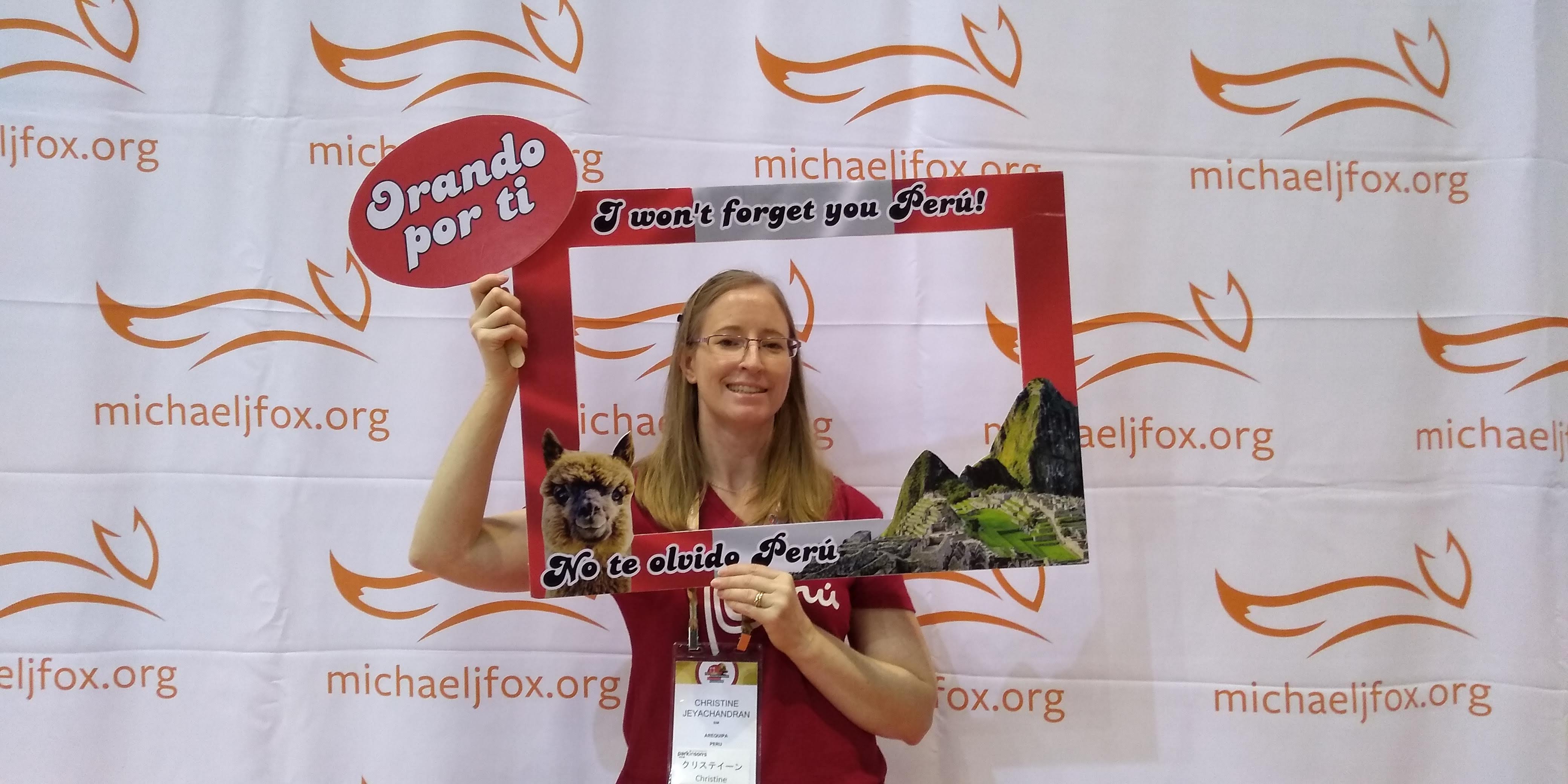
World Parkinson’s Congress 2019 Kyoto JAPAN

The World Parkinson’s Congress in Japan was amazing and life changing. Researcher from around the world joined with patients and carers to hear and share about the latest scientific developments and support each other in this journey called Parkinson’s disease.

A reception for Australian’s got me started on networking. There were hundreds of Aussies and over 60 countries represented. I was the only one from Peru.

I heard talks about advocacy, diet, the best exercise, depression/ apathy and anxiety and coping with early onset Parkinson’s with family/work. Some scientific talks that went over my head and others I’m reviewing at home to remember. I did yoga, a dance class and tango which was so empowering.

I met people from all around the world and I especially tried to connect with Latinos and Spanish people and encouraged people to come visit us in Peru and maybe volunteer there.
I told everyone about how tough it is for sufferers in PERU but was so excited to hear next time it will be in Barcelona so that means Peruvians can attend as the conference will be translated into Spanish as well.
My video did not win – but thanks again to everyone who voted nonetheless. The winning video was professional, one of four entries by the same person and about a legendary campaigner/PWP in the Parkinson’s world who had passed away suddenly. A worthy winner indeed.
It was amazing to see how different the symptoms were around us and that there must have been over 200 people under 55 with Parkinson’s at the conference. Over 2000 people attended from 60 countries.
I loved it so much that I can’t wait for World Parkinson’s Congress in 2022. #WPC2022

Knowing Spanish, I hope I might help in some way with organisation as it is run by a small NGO and as you can imagine it is a mammoth undertaking and they need volunteers to help run it. Maybe you could come and volunteer too.  

Projects and persistence in gymnastics

To go along with the video I have renamed the blog “Handstand for Parkinson’s” and the website is www.handstandforparkinsons.com. I hope this won’t cause too much confusion.

The other news is that I am preparing a Poster “Living with Parkinson’s in Peru”. So I am super busy trying to interview people with the disease and write up their stories and creating charts. I have never done something like this and with the time limit so close (June). I am a bit overwhelmed and have ideas that I am struggling to put into action.

Thanks everyone for your votes and support with the video “Handstanding for Parkinson’s Disease”. I have been so blessed by comments and with votes. The winner isn’t announced until June, but voting has finished.

We’re preparing for our 3 month visit to Australia late May to August which is exciting too.

The fun news is that I am working on a follow-up video called “Before and After” about how my coordination, movement balance and strength  improved by doing gymnastics to combat Parkinson’s. It is half done so watch this space. I am relatively new to video editing so it is taking me time to learn but I’m advancing little by little.

Also I am back at the gym training pretty hard but like pride before the fall my handstand has gone backwards. Firstly my coach prefers that I don’t use a wall for support and secondly I am still frightened and lack consistency in my style. I need to keep practicing! Everyone has these valleys or plateaus but I am working hard. My next video will include some new tricks I am working on… of course I’m not looking like a pro but I’m moving forward nonetheless. April marks the first anniversary of my time in the gym.


TED Talk Tips – plus change of blog name to Handstand for Parkinson’s

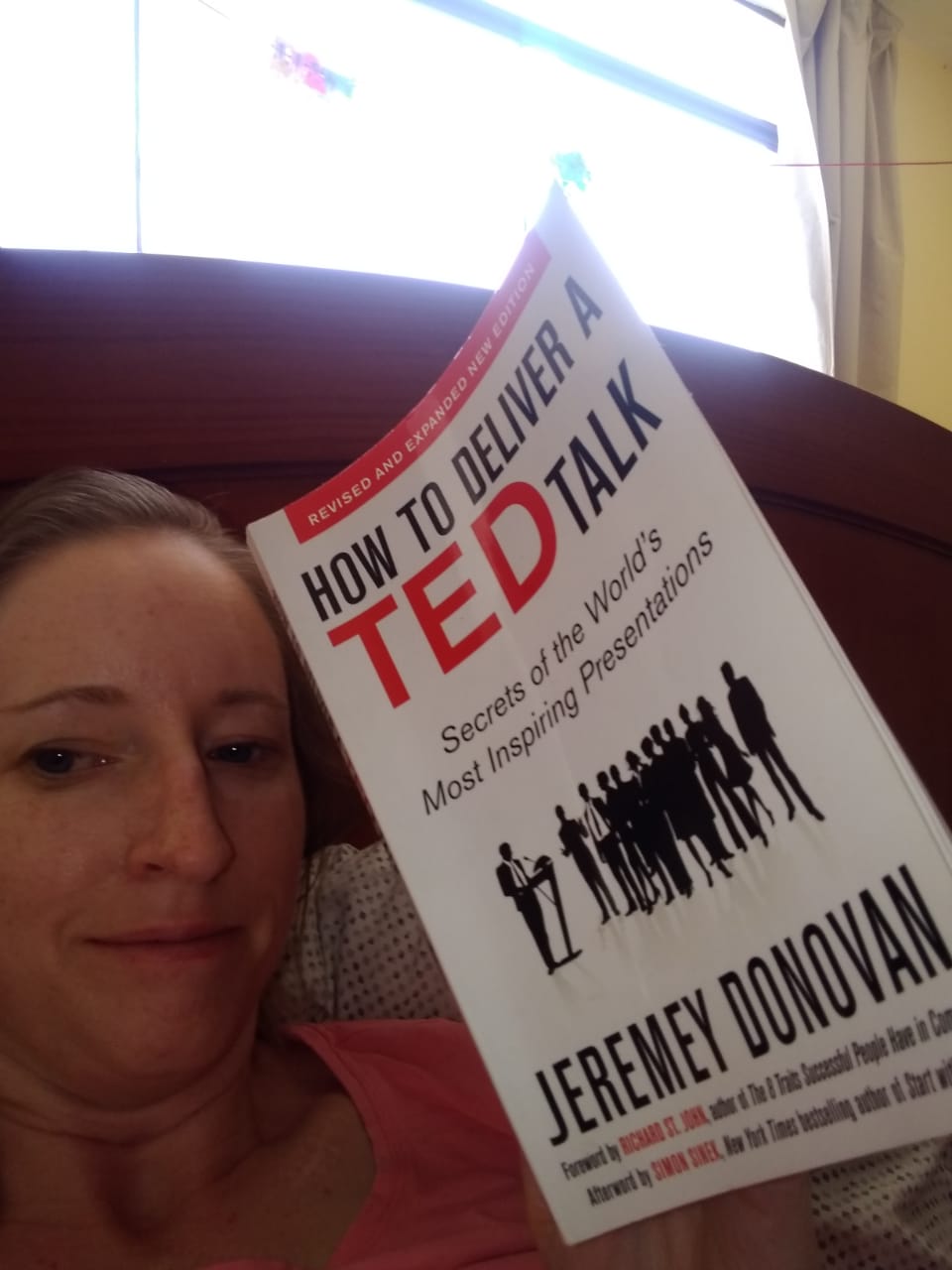
Was feeling a bit sick this day so lay in bed reading this book. Love it.

I really love TED talks and I found a book on a friend’s shelf “How to deliver a TED talk”. I quickly asked to borrow it. I have always enjoyed public speaking and inspired by the book I drafted a talk about “an idea worth spreading” which is the catchphrase of TED. I’m giving a talk next week so it is perfect timing.

As I kept reading I now see many changes that need to be made, but I knew If I didn’t draft it today I would forget all the good advice from the book.

The first tip that stood out was you need a catchphrase, summarising your main idea(s) ideally short 3-12 words, action centric and include word repetition, rhythm or even poetry. Not all are possible at once but it should be repeated various times.

The second tip I really liked was that you need to catch your audience’s attention in the first 30 seconds. If not, it’s really hard later. There are extensive list of how to do this but I won’t give it all away (Jeremey Donovan wouldn’t like that)

There are lots of tips to fine tune my talk but for me this time the stakes are not as high as doing a real TED talk. But this leads to the next tip I am following already. You need lots of real life practice to get good at public speaking. Without this it is unlikely you’ll get on TED. But that said it is not about being an expert speaker, but a passionate expert in your particular area.

You can nominate yourself to be on TED but if others do, it is even better.

I am excited now to improve my public speaking skills so will continue to take opportunities to share “my idea worth sharing” (that’s another blog post).

I’d love share in your community or church group or Parkinson’s group. I’ll be in Australia from June to August. Other locations could be harder but you never know, I love to travel.

I better get back to writing my speech for World Parkinson’s Day on 11th April which will be in Spanish. This is no easy task in another language. I’ll need even longer to practice and memorise this one. I better get to work.

PS. I am attempting to move all media to name: Handstand for Parkinson’s (often without apostrophe). I am told this is better – uniformity. A work in progress as it is a bit mixed.

Finalist of Video Competition. FINALISTA DE COMPETENCIA DE VIDEOS

https://www.youtube.com/watch?v=h1B6kUgN6WQ&t=6s

My video has been chosen as one of the 12 finalists for the World Parkinson’s Congress. I am elated. There are 2 winners. One chosen by judges and one by people’s choice by popular vote. So I have to encourage you all to vote online in the link (voting has now finished) and encourage others to vote too. You need use your email address.

Christine Allison Jeyachandran​- Mi video sobre aprendiendo parada manos/ gimnasia está concursando en el congreso mundial de Parkinson, entren en el link y voten por mi! 😁 He sido elijo en los finalistas (12)…. Muy Feliz!!!!!!!!!!!!!! Los intrusiones son en ingles pero dice, votar una vez no más. El nombre de mi video es Hand Standing for Parkinson’s Disease by Christine Jeyachandran. Pon su nombre apellido y email y buscar mi video para votar (Ya termino votacion). Gracias y animar a otros votar. Compartir por favor

If you knew the future….

Two of my children joined me to encourage me over the finish line.

If you knew that in the future you’d be unable to walk properly, you’d be motivated to do whatever you could now.

This year I did the ‘Race to the Rocks’ at our mission organization annual conference. It is 7.2km on the beach so it’s quite an effort, I wasn’t even sure I was going to finish it. I left first and was last back but I finished the race. It is also important as a parent to be an example of participation even if it is not your thing (running is not my thing so I mainly walked). Most people prefer to sleep in, me too actually, but I might not be able to do it one day so I should do it while I can. That doesn’t mean to say it was easy because I struggle walking and after the race I was quite exhausted but I finished it.

This last Sunday we all went in a set of races: I went in the family category(3km) and Samuel ran ahead with a friends family. The twins did 4.5km and David 10km. I walked most of the way even though it was a ‘run’. I am thankful I could do it and enjoy it.

“But you, keep your head in all situations, endure hardship, do the work of an evangelist, discharge all the duties of your ministry.

For I am already being poured out like a drink offering, and the time for my departure is near. I have fought the good fight, I have finished the race, I have kept the faith.” 2 Timothy 4: 5-7S

Si supieras el futuro….

Si supieras que en el futuro no podrías caminar correctamente, estarías motivado para hacer lo que pudieras ahora.

Este año hice la “Carrera a las rocas” en la conferencia anual de nuestra organización misionera. Hay 7,2 kilómetros en la playa, así que es un gran esfuerzo, ni siquiera estaba seguro de que lo iba a terminar. Salí primero y llegue la última vez pero terminé la carrera. También es importante como padre ser un ejemplo de participación, incluso si no es lo tuyo (correr no es lo mío, así que principalmente caminé). La mayoría de la gente prefiere dormir, yo también en realidad, pero tal vez no pueda hacerlo un día, así que debería hacerlo mientras pueda. Eso no quiere decir que fue fácil porque lucho para caminar y después de la carrera estaba bastante agotado, pero lo terminé.

El domingo pasado, todos fuimos a un conjunto de carreras: entré en la categoría familiar (3 km) y Samuel corrió con una familia de amigos. Los mellizas hicieron 4.5km y David 10km. Caminé la mayor parte del camino a pesar de que era una “carrera”. Estoy agradecida de poder hacerlo y disfrutarlo.

Video: Handstanding for Parkinson’s Disease!

I took a challenge to learn to handstand. It was lot of hard work to build up the muscles and prepare my body. I have made a short documentary about the process and the obstacles I faced. Please watch for the full story.

https://www.youtube.com/watch?v=h1B6kUgN6WQ&feature=share

I am raising funds to attend the World Parkinson’s Congress in Japan in June 2019 (funds will cover my flights/ accommodation/ registration) and in addition I am funding an education project for Parkinson’s sufferers in Peru. I’d like to raise awareness about Parkinson’s disease and the importance of exercise in preventing disease progression in Peru. Going to the Congress will help resource me for this purpose and on a personal level too. Please read my blog post  Peru and Parkinson’s Disease  for more information. It is a huge need and it breaks my heart to see people suffer unnecessarily. 

I challenge you to Handstand for Parkinson’s Disease too. 

1. Do a Handstand for Parkinson’s Disease (Read below first!) 

2. Post a Picture/ Video to facebook #handstandforparkinsonsdisease

3. Make a donation

https://www.gofundme.com/hand-stand-for-parkinson-disease

4. Nominate 2 Friends to “Handstand for Parkinson’s Disease” 

5. The challenge continues…. 

Handstanding: 
Please don’t try this if you don’t know how. Be responsible and if you want to learn, join an adult gymnastics class like I did. You would have until 1st of June to add your photo. 

I challenge you to make a donation to the cause on this page. Small or Large – as your heart leads you.

Thank-you for donating.