“You are indeed an ambassador- of hope! Thank-you for the gift of honest, practical help. I know I’m just one of the many your example has touched” wrote Phillip Yancy a well known author.
I had written to Phillip as a response to his blog about his Parkinson’s Diagnosis – I explained, countrary to his belief, that he did not have to give up exercise and adventures as he thought he might have too – as exercise is crucial to help live well with Parkinson’s. (I wrote a bit more of an introduction to myself too)
One of the unexpected joys of my journey with Parkinson’s has been that I have been able to inspire people to have hope despite their diagnosis of Parkinson’s.
I have had so many wonderful and enouraging comments come my way that motivate me to keep sharing my story, even though it may be old news to my readers and others.
– Many have not heard about the benefits of exercirse.
– Many see a Parkinson’s diagnosis as the beginning of the end! (it does not have to be).
– Many are inadvertently fulfilling the prophesy to degenerate (while I try pretty hard to avoid degenerating).
And I keep telling my story because people don’t know the symptoms of Parkinson’s Disease and we need to raise awareness
– so people can get diagnosied early with the disease and get treatment earlier.
– so people can help the people they know diagnosed with Parkinson’s get the care and exervcise support they need.
– and to fight for a cure. My hope is that young people are inspired to go into research to cure Parkinson’s
– Finally the universal nature of the struggle is clear in my story and has something in it most people can identify with and this helps create empathy.
As I struggle to look after my health – to exercise and to eat well, I was willing to be vulnerable and show others that we all need help and through sharing my journey this year I hope to learn from others too.
I am willing to share a bit of my pain and frustration so we can learn together. Are you willing to turn up everyday?
Please share with me your story too. Sign up for my blog and youtube Channnel.
thanks Christine
PS – My comment to Phillip Yancy is no longer online but you can read his blog by searching his name and Parkinson’s
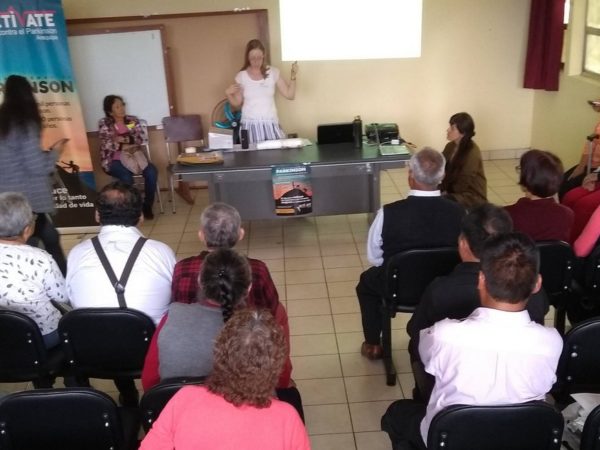
That may seem a strange question to use in a Parkinson’s association meeting. But that what I asked is very strategic. These people have parkinson! They have plenty of weaknesses. They are used to people asking them about symptoms and many suffer from depression, anxiety and lack of motivation. It is part of the disease though everyone is affected differently do not everyone has it.
The other reason I use such an approach is because I did a Masters in Community Development which is an aspect of social work and international development which approaches development from a different perspective. The role of the community development worker is to help the people themselves.
One of the key methods is asset-based development. Instead of going in and asking ‘what do you need’ or condescending statements or questions about their situation they look at the strengths they have. Helping people find their strengths means helping them see their worth and see how that could help each other. That is one of my aims with Activate – the Liga of Parkinson’s en Arequipa.
I also wanted to avoid the tearful diagnosis stories this meeting and keep it more positive. Not to say we won’t do these stories but not everytime we meet. Instead we started with singing, actions and dancing to a children’s song with a good latino rhythm. This helped everyone loosen up and have a bit of fun.
Feeling useful and valued brings people joy and my strategy is to get people involved in running the Liga. Let’s be honest it is a lot of work alone so having help will lighten the load too especially as the people get the hang of what is involved. Family of the people with
Parkinson’s are also invited to help out too.
We are hoping to start some sort of exercise classes for those interested so I asked if people could help find a location and teachers and or funding or the user pays. It could take some time.
We also had life size person outline on paper and we had everyone yell their symptoms, and we put up the labels on the body of where they related to. They enjoyed being the experts on the disease as we of people learn about symptoms others have.
We had about 16 people with Parkinson’s plus family. I have 42 contacts with Parkinson’s now and the Doctor just rang to say she has more people wanting to come so we a have penciled in the 11th of February for the next meeting in the same venue to keep things moving.
In all, exciting meeting and we hope and pray the enthusiasm continue.
Disability in Mission – the Churches Hidden Treasure, Edited by David C Deuel and Nathan G John
“Should you be going back to the mission field, considering your condition?” This is the question often asked of me. I was diagnosed 6 years ago on the mission field with Parkinson’s Disease at the premature age of 37. So when I found this book, I’d already been exploring its themes. But new insights came page by page through the wisdom and experience of the writers.
The point of the book is illustrated by the true story of a deacon, in the early church, burned to death because of his actions.
“Lawrence …. was ordered to bring the treasures of the church before the emperor. He collected all the poor, the sick, the lame, the elderly and disabled people he could find. Took them to the emperor and said ‘See, here are the treasures of the Church’.
The book links Biblical examples of weakness and treasure. God gives Paul strength to shine in darkness to display the face of Christ. Likewise, God says, “I will give you hidden treasures, riches stored in dark places, so that you may know that I am the LORD” (Isa 45). Paul celebrates his weakness and fragility, and the stories of the book reveal how God is glorified in the weaknesses of other humble servants.
Joni Ereckson Tada, who writes the forward, knows firsthand the ministry God brought to her because of her quadriplegia. Not easy but fruitful. The previously untold stories in the book reflect that ‘the parts of the body that seem to be weaker are indispensable’ (1 Cor 12:22). Sadly, we don’t often value every part of the body of Christ. As Nathan Johns writes:
“Often society assumes the worst about people with disabilities. They are considered as weak. Yet each of the powerful testimonies here affirms how God chooses weak people, equips them powerfully by his grace, and works through them” (and) “creatively beyond what we could imagine”.
We are all made in God’s image, each of us is loved by God and is used for his purpose.
Without giving away all the stories nor Bible references, I liked the story of a down syndrome child born to missionaries in Indonesia. In this society, and many others, they believe that a disability is the result of a curse, generational sin, or divine judgement. This child became an example of hope. They saw how this child with downs was loved and encouraged to reach her full potential, and it gave local mothers hope for their children who were different. The position of the child’s mother changed as her suffering meant “Indonesians now perceived me as being more approachable….shared weakness was like a bridge”. The book tells of people watching disabled persons or their carers and getting new perspectives on their own situation. Even being present and united in weakness can encourage others and challenge the status quo. Others’ lives have changed completely like the editor Nathan John’s, whose daughter’s disability, inspired him to coordinate community disability services all over India.
Many disabled people serve God by teaching and preaching, others vocationally and others as disability advocates. Seeing a person worshipping God in spite of their problems shows their love for God, and people start to ask questions like: “If God can give joy to the quadriplegic then I want to know more” (of Joni Erekcon Tada). Many know that life is easier in the west and think ‘yet they are here serving my people’. This speaks volumes.
God used beatings, stonings, shipwrecks and imprisonment and a thorn in Paul’s side to keep him humble and dependent on him. All in missions need to depend on God whatever the situation.
On a practical side, when disability is present we need to evaluate carefully on a case by case basis the access to needed support services, regarding health or emotional services and practicalities. Extra costs don’t need to prevent service, but prayer is needed. My mission has evaluated my situation and approved me for service. So I’m excited to be back in Peru and love reaching out to people I’d never have thought to serve.
My disease has given me a chance to speak in many meetings and churches and my videos that tell my story have been seen by thousands of people, many who say ‘you are inspiring’.
I’m just following God’s call and I’m blown away as I see how God turns weakness to his strength. It’s not easy but I hope others inspired by the book will serve God, disabled or not. I loved the book and highly recommend it to anyone even if you don’t know disabled people. I pray it touches you as it did me.
……………………..
Christine Jeyachandran serves with her husband David and kids in Peru with student and women’s ministry and more recently with people with Parkinson’s Disease. Here video Handstand for Parkinson’s was a finalist for the World Parkinson’s Congress video competition: