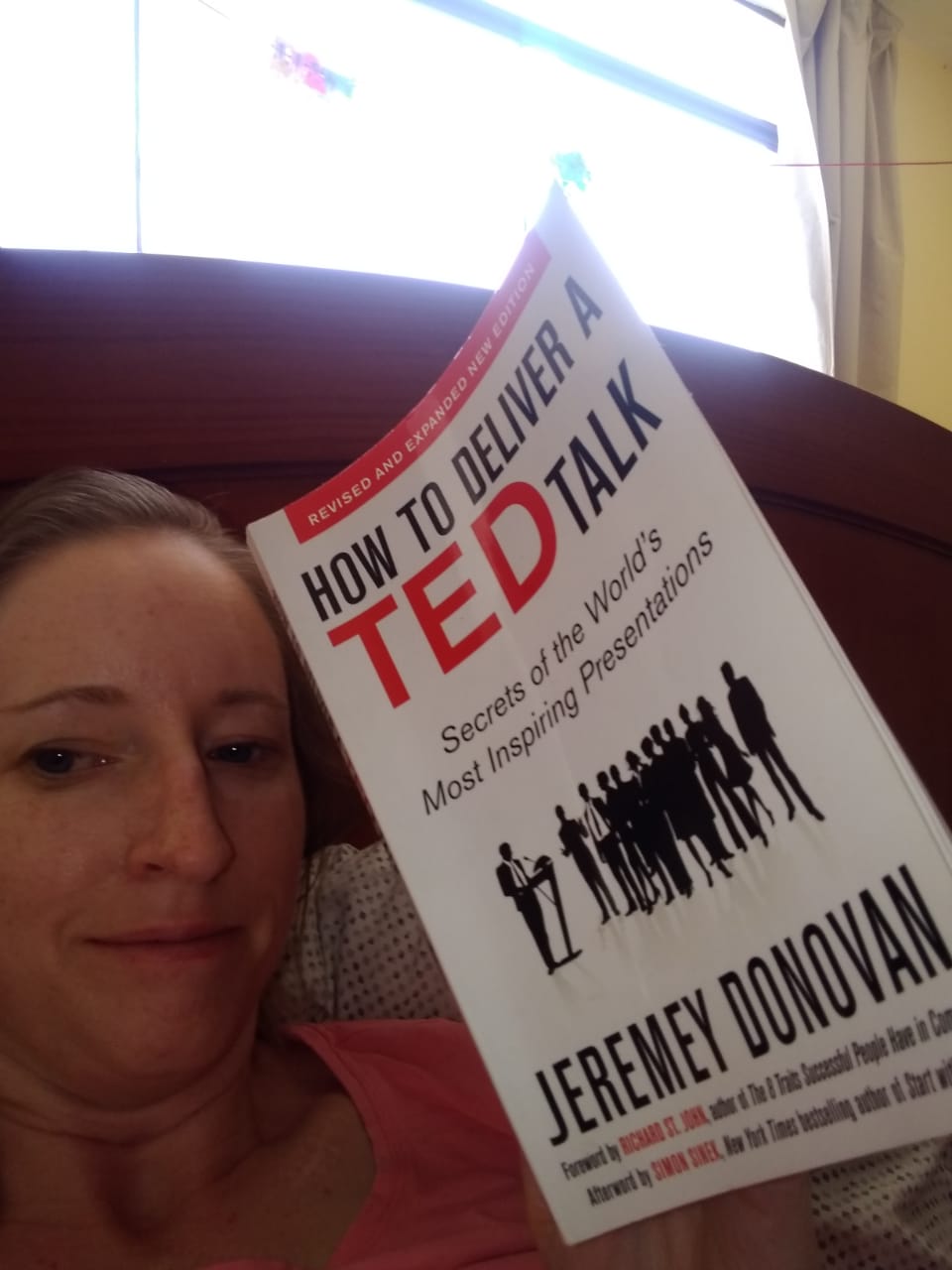
Was feeling a bit sick this day so lay in bed reading this book. Love it.
I really love TED talks and I found a book on a friend’s shelf “How to deliver a TED talk”. I quickly asked to borrow it. I have always enjoyed public speaking and inspired by the book I drafted a talk about “an idea worth spreading” which is the catchphrase of TED. I’m giving a talk next week so it is perfect timing.
As I kept reading I now see many changes that need to be made, but I knew If I didn’t draft it today I would forget all the good advice from the book.
The first tip that stood out was you need a catchphrase, summarising your main idea(s) ideally short 3-12 words, action centric and include word repetition, rhythm or even poetry. Not all are possible at once but it should be repeated various times.
The second tip I really liked was that you need to catch your audience’s attention in the first 30 seconds. If not, it’s really hard later. There are extensive list of how to do this but I won’t give it all away (Jeremey Donovan wouldn’t like that)
There are lots of tips to fine tune my talk but for me this time the stakes are not as high as doing a real TED talk. But this leads to the next tip I am following already. You need lots of real life practice to get good at public speaking. Without this it is unlikely you’ll get on TED. But that said it is not about being an expert speaker, but a passionate expert in your particular area.
You can nominate yourself to be on TED but if others do, it is even better.
I am excited now to improve my public speaking skills so will continue to take opportunities to share “my idea worth sharing” (that’s another blog post).
I’d love share in your community or church group or Parkinson’s group. I’ll be in Australia from June to August. Other locations could be harder but you never know, I love to travel.
I better get back to writing my speech for World Parkinson’s Day on 11th April which will be in Spanish. This is no easy task in another language. I’ll need even longer to practice and memorise this one. I better get to work.
PS. I am attempting to move all media to name: Handstand for Parkinson’s (often without apostrophe). I am told this is better – uniformity. A work in progress as it is a bit mixed.
Everyone is asking: Yes I am back at the gym training with my coach, trying crazy things. M y daughter, Amelia, has pointed out I am doing this wrong and how to fix it. Little by little.
Anything in addition to the target goes towards an educational campaign for patients, families and interested health professionals. Today I met with a Parkinson’s sufferer who has lost faith in doctores, who don’t give patients enough time to educate them properly, explain repercussions of drugs (like laxatives) nor the importance of nutrition, exercise, exercises for the voice, self care and the prevalence of depression and how to confront the disease. Looking back maybe I got more time, being the gringa because I was firing question after question despite noticing the doctores desire to say “next” written all over his/her face. But even then the responses were simple ” yes physiotherapy could help”. I am working one on one to educate but more is needed. I know I have been an encouragement but thinking of a team of people educated in Parkinson’s to deal with this nasty disease properly. People able to model love and kindness and willing to go to the regional centres too.
According to the World Health Organisation 7 million people around the world have Parkinson’s disease. In Peru there are no official statistics but it is it is estimated that 30,000 people suffer with Parkinson’s and every year 2000-3000 new cases are found.
But from observation and comments of friends here, people hide disabilities or they can be undiagnosed so the numbers could be higher.
The treatment and lack of education about the disease is concerning.
Diagnosis of Parkinson’s disease in Peru is usually done by a neurologist but outside of the capital there are no Parkinson’s specialist neurologists (registered as Movement specialists) and this can cause a variance of treatment. Unfortunately ‘Levodopa’ is prescribed from the beginning of the disease when it should be prescribed after about five years according to Doctor. Cesar Casteñada, Neurologo, Movement Disorders Specialist de Lima. The Parkinson’s medication “levodopa” has a shelf life and becomes less effective with time, and can even stop working after 5-10 years. Other drugs called Antagonists should be prescribed but they are expensive and may not be covered by health insurance in Peru (public or private).
Aside from drugs, the most important treatment that slows the diseases advancement is exercise but doctors here rarely mention this. One does not get a lot of time with the specialist and patient education is not a priority. It’s possible that doctors are not trained in what to recommend in terms of exercise therapy. Likewise referring people to a physiotherapist may lead to the same problem as in my experience in a regional city, physiotherapists lack training too.
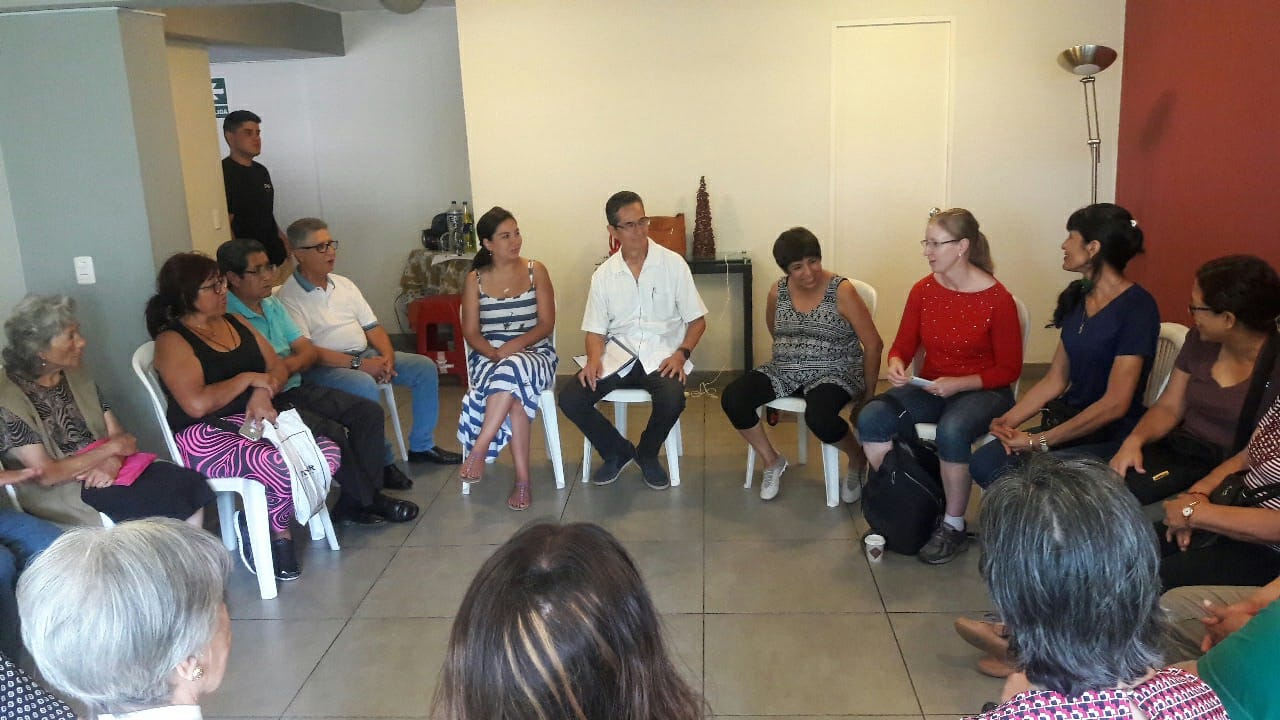
What is needed is an expansion of the education about Parkinson’s disease for patients, their families and the medical community. Recently I attended the Parkinson’s Association meeting in Lima and found it to be so beneficial for the people emotionally as we connected with others like us. We became more educated about the disease and the event finished with some physical therapy which encouraged people and informed them about what they could do to help prevent the disease getting worse. We all participated and had fun.
Let me give you one case study that shows the benefits of education and of Parkinson’s sufferers meeting together. Over the last 6 months I have been chatting on WhatsApp and by phone with a lady of about 49 years of age with severe Parkinson’s. I’ve encouraged her about doing exercise, sent her videos of simple things she could do and articles to read about benefits of exercise and how to have a positive attitude. I pray for her too but unfortunately she never said she did any of the exercises. She was encouraged by our friendship but was often depressed and didn’t want to go out. She wanted to meet me and go to the Parkinson association meeting so she came all the way to Lima from a city 12 hours away. She attended the meeting and I could see that the people around her encouraging her and challenging her about some of the things that I have been saying for months. When she got home she found it hard because her symptoms were getting worse and the drugs weren’t working as well as they did before, but then she wrote me saying she was meeting someone else with Parkinson’s disease and she was realising the importance of exercise and they were doing it together. She realised with her diseases advancement she had to exercise and stretch as the drugs didn’t help much. Amazing progress.
She benefited from both the educational meeting of the Parkinson’s Association and uniting with other people who had the disease – this was a great encouragement to her. This is needed across Peru.
PS- There are many more stories to tell and more stories and background can be found in previous blogs.
Según la Organización Mundial de la Salud, 7 millones de personas en todo el mundo tienen la enfermedad de Parkinson. En Perú no hay estadísticas oficiales, pero se estima que 30,000 personas sufren de Parkinson y cada año se detectan 2000-3000 casos nuevos. Pero a partir de la observación y los comentarios de amigos aquí, las personas ocultan discapacidades o pueden ser no diagnosticadas para que las cifras sean más altas.
El tratamiento y la falta de educación sobre la enfermedad es preocupante. El diagnóstico de la enfermedad de Parkinson en Perú generalmente lo realiza un neurólogo, pero fuera de la capital no hay neurólogos especialistas en Parkinson (registrados como especialistas en Movimiento) y esto puede causar una variación del tratamiento. Desafortunadamente, “Levodopa” se prescribe desde el principio de la enfermedad cuando debe recetarse después de unos cinco años, según el médico. Cesar Casteñada, Neurologo, Especialista en Trastornos del Movimiento de Lima. El medicamento “levodopa” de la enfermedad de Parkinson tiene una vida útil y se vuelve menos efectivo con el tiempo, e incluso puede dejar de funcionar después de 5-10 años. Se deben recetar otros medicamentos llamados Antagonistas, pero son caros y es posible que no estén cubiertos por el seguro de salud en Perú (público o privado).
Aparte de los medicamentos, el tratamiento más importante que retarda el avance de las enfermedades es el ejercicio, pero los médicos aquí rara vez lo mencionan. Uno no tiene mucho tiempo con el especialista y la educación del paciente no es una prioridad. Es posible que los médicos no estén capacitados sobre qué recomendar en términos de terapia de ejercicios. Del mismo modo, remitir a las personas a un fisioterapeuta puede llevar al mismo problema que en mi experiencia en una ciudad regional, los fisioterapeutas también necesiten capacitación.
Lo que se necesita es una expansión de la educación sobre la enfermedad de Parkinson para los pacientes, sus familias y la comunidad médica. Recientemente, asistí a la reunión de la Asociación de Parkinson en Lima y descubrí que era muy beneficioso para las personas emocionalmente, ya que nos conectamos con otros como nosotros. Nos educamos más acerca de la enfermedad y el evento terminó con una terapia física que alentó a las personas y les informó sobre lo que podían hacer para ayudar a prevenir que la enfermedad empeorara. Todos participamos y nos divertimos.
Permítame darle un estudio de caso que muestra los beneficios de la educación y la reunión de los pacientes de Parkinson. Durante los últimos 6 meses he estado hablando en WhatsApp y por teléfono con una mujer de unos 49 años de edad con Parkinson grave. La alenté a hacer ejercicio, le envié videos de cosas simples que podía hacer y artículos para leer sobre los beneficios del ejercicio y cómo tener una actitud positiva. Ore por ella también, pero desafortunadamente ella nunca dijo que hizo ninguno de los ejercicios. Nuestra amistad la animaba pero a menudo estaba deprimida y no quería salir. Quería reunirse conmigo e ir a la reunión de la asociación de Parkinson, por lo que vino a Lima desde una ciudad a 12 horas de distancia. Ella asistió a la reunión y pude ver que las personas a su alrededor la alientan y la desafían por algunas de las cosas que he estado diciendo durante meses. Veía la muy atenta. Cuando llegó a casa, lo encontraba difícil porque sus síntomas empeoraron y las drogas no funcionaban tan bien como antes, pero luego me escribió diciendo que estaba con alguien más con la enfermedad de Parkinson y que se estaba dando cuenta de la importancia del ejercicio y lo hacían juntos. Se dio cuenta de que con el avance de sus enfermedades tenía que hacer ejercicio y estirarse ya que las drogas no ayudaban mucho. Increíble progreso.
Se benefició tanto de la reunión educativa de la Asociación de Parkinson como de la unión con otras personas que tenían la enfermedad, esto fue un gran estímulo para ella. Esto es necesario en todo el Perú.
PD: Hay muchas más historias que contar y más historias y antecedentes se pueden encontrar en blogs anteriores.
This is more information about a Parkinson’s meeting I attended in Lima in January. That may seem boring to some but the next two characters certainly ensured it was not boring. Also see previous blog about the shocking misdiagnosis of a lady who attended.
Joy
One of the first persons to meet us was a vibrant lady in her early 50’s who had had the disease since she was 28 years old. Lets call her “Joy” as that she was, she immediately told us her story, including the trials of being called a drunk but most of all she was encouraging people “keep moving”, “don’t cry” , “do exercise” and “you can do it”.
She was quite the chatterbox but I could see my friend who’d taken a 12 hour bus to meet me at the meeting moved by her positive example. I enjoyed seeing her encouraged by someone else to do all the things I’d been encouraging her to do. It was nice I could remain silent and let Joy do what came naturally. Thank God for people like Joy who inspire us.
Movement Therapist
She was a pocket rocket – small but strong. From the get go she had us eating from her hand as she sang huskily along to the music and moved her hips and arms as only a latino can. She asked us all to join in (as we could) and ‘feel’ the music. This was the warm up and people who’d been in tears minutes earlier sang along and moved with enthusiasm. What a great way to warm up that anyone can do – limited movement or not. Music warms the soul and helps you move and smile. The exercise therapist then taught the group some basic stretching movements.
Everyone had a great time and I joked she needed to come to Arequipa every week (1.5 hours by plane). She does have a regular slot in Lima where older folk can go and the association can pass on the details.
Again the positive outcomes of having Parkinson’s association meetings are clearcut. We can encourage each other and exercise together and I am hoping we can replicate in our city.
Gozo Personificada
Esta es más información sobre una reunión de Parkinson a la que asistí en Lima en enero. Eso puede parecer aburrido para algunos, pero los siguientes dos personajes sin duda aseguraron que no fuera aburrido. También vea el blog anterior sobre el sorprendente diagnóstico erróneo de una señora que asistió.
Gozo Una de las primeras personas que conocí fue una dama vibrante de unos 50 años que había contraído la enfermedad desde que tenía 28 años. Llamémosla “Alegría” como era, inmediatamente nos contó su historia, incluidas las pruebas de ser llamada borracha, pero sobre todo estaba animando a la gente a “seguir moviéndose”, “no llorar”, “hacer ejercicio”. Y usted puede hacerlo”. Ella estaba bastante en el chatterbox pero pude ver a mi amiga que había tomado un autobús de 12 horas para reunirse conmigo en la reunión conmovida por su ejemplo positivo. Disfruté viéndola animada por alguien más para hacer todas las cosas por las que la había alentado. Fue agradable poder permanecer en silencio y dejar que Joy hiciera lo que era natural. Gracias a Dios por personas como Joy que nos inspiran.
Terapeuta de movimiento Era un cohete de bolsillo, pequeña pero fuerte. Desde el principio, nos hizo comer de su mano mientras cantaba con la música y movía sus caderas y brazos como solo un latino puede. Nos pidió a todos que nos uniéramos (como pudiéramos) y “sintiéramos” la música. Este fue el calentamiento y las personas que habían estado llorando minutos antes cantaban y se movían con entusiasmo. Qué gran manera de calentar que cualquiera puede hacer, movimiento limitado o no. La música calienta el alma y te ayuda a moverse y sonreír. El terapeuta de ejercicios enseñó al grupo algunos movimientos básicos de estiramiento. Todos la pasaron muy bien y yo bromeaba que ella necesitaba venir a Arequipa cada semana (1.5 horas en avión). Ella reside en Lima, donde la gente mayor puede ir y la asociación puede transmitir los detalles.
Nuevamente, los resultados positivos de tener reuniones de la asociación de Parkinson son claros. Podemos animarnos mutuamente y hacer ejercicio juntos, y espero que podamos replicar en nuestra ciudad.
“According to my evaluation you may not even have Parkinson’s Disease!” said the doctor to the lady in front of us. I was in Lima briefly and attended a meeting of the Parkinson’s association which has recently formed or revived. It quickly became clear how invaluable this meeting was and the power these meetings if they could be held throughout Peru. A guest Parkinson’s Doctor evaluated 4 cases (not mine) and one lady had this said to her.
I met another who I wondered àbout her diagnosis and worse still her doctor had encouraged her to have surgery. Thankfully she hadn’t been operated on and was evaluating her symptoms. Both had hands shake when nervous but this is not symptom of PD necessarily. A tremor at rest is one of the first symptoms of the disease.
The second shocking news; most at the meeting had been prescribed a drug called Levadopa at diagnosis. Our visiting expert said that it should not be prescribed until about 5 years after the diagnosis. As time progresses you need to take more and more of thi to get the same effect. Even I was prescribed Levadopa on diagnosis but with my GP with us, we corrected that quickly. Looking back I believe it was my GPs insistence not the doctor.
This information needs to be spread amongst the PD community in Peru as evidently doctors or neurologists are often not movement specialists which is what specialists in Parkinson’s disease are called and sadly outside of Lima there are no movement specialists (an area of neurology). The patients are also restricted in who they see depending on their insurance or financial capacity but a list of movement specialists in Lima can be obtained. I will endeavor to get an updated list to share. Not all doctors are equally trained or knowledgeable.
I didn’t expect such a meeting outcome. Much more to report soon just as interesting. “
“Es posible que ella ni siquiera tenga la enfermedad de Parkinson” (no a mi)
“¡Según mi evaluación, es posible que ni siquiera tenga la enfermedad de Parkinson!”, Dijo el doctor a la señora que estaba frente a nosotros. Estuve en Lima brevemente y asistí a una reunión de la asociación de Parkinson. Rápidamente se hizo evidente cuán valiosa era esta reunión y el poder de estas reuniones si se pudieran celebrar en todo el Perú. Un médico de Parkinson invitado evaluó 4 casos (no el mio), a una de la 4 personas le dijo que no era Parkinson lo que tenía.
También conocí a otra persona (recien diagnosticado), yo me preguntaba sobre su diagnóstico y fue peor aún, su médico la había alentado a que se sometiera a una cirugía. Afortunadamente, no había sido operada porque sus síntomas de la enfermedad eran pocos (pero no soy médico). A ambos les temblaban las manos cuando estaban nerviosos, pero esto no es necesariamente un síntoma de la EP. Normalmente el temblor es en reposo con la enfermedad de parkinsons (EP) cuando se diagnostica.
La segunda noticia impactante; a la mayoría en la reunión se le había prescrito un medicamento llamado Levadopa en el momento del diagnóstico. Nuestro experto visitante dijo que no se debe prescribir hasta aproximadamente 5 años después del diagnóstico. Este medica, por lo que no debe comenzar a tomarlo demasiado pronto. A medida que avanza el tiempo, debe tomar más y más para obtener el mismo efecto. Incluso a mi me recetaron Levadopa en el diagnóstico, pero con mi médico de cabecera lo corregimos rápidamente. Mirando hacia atrás, creo que fue la insistencia de mi médico de cabecera y no el médico de EP.
Esta información debe distribuirse entre la comunidad de Parkinson’s en Perú, ya que, evidentemente, los médicos o los neurólogos no suelen ser especialistas en movimiento, que es como se llaman los especialistas en la enfermedad de Parkinson y, lamentablemente, fuera de Lima no hay especialistas en movimiento (un área de neurología). Los pacientes también tienen restricciones en cuanto a quién ven, dependiendo de su seguro o capacidad financiera, pero se puede obtener una lista de especialistas en movimiento en Lima. Me esforzaré por obtener una lista actualizada para compartir. No todos los médicos están igualmente capacitados o bien informados.
No esperaba tal resultado de la reunión.
Manténgase en sintonía para la segunda igualmente interesante.
I’ve got a friend with Parkinson’s disease who feels alone. She doesn’t go out of her house unless she’s medicated and she has long off periods. She drags her feet when she walks and is embarrassed generally by the disease. She is self-conscious. Even her neighbours haven’t seen her walking. Why does she have such an attitude?
Peruvians tell me that there is prejudice against people with disability. They create a financial strain on their family and community. You don’t see many disabled on the streets except a few regular beggars. People hide away disabled family members. Children with disabilities are not exposed to normal outings and parents have low expectations of them which become self-fulfilling. One person was told not to touch an autistic children (as if it could be contagious). This is clearly unloving towards the child and exacerbates the disability further.
I created Facebook group for Parkinson’s Disease in my city with the idea of educating others about the disease and encouraging people to meet up to do exercise together. But people with Parkinson’s don’t want to come out. They may also be frightened of meeting someone new.
Why? It is a low trust society but also they could have mobility issues (taxi’s are expensive) or it might relate to other people’s attitude to them. Often disability in the family leads to people believing it is somehow the fault of the family. Maybe it is the fault of the parents or discipline from God. There is also a lot of superstition so they look for something or someone to blame.
If they go to church they sometimes get told to pray for healing and have faith more God. And if no healing happens they don’t want to go to church anymore. Worse still, one friend said they’ll go from religion to religion or to the witch doctor to a quack doctor looking for something that helps but never committing to any religion fully – he called it religion shopping.
So when people find out ‘the missionary’ has a disease they are shocked and tell me what they have been told “I need to pray and have faith”. Paul had huge faith and God didn’t heal him and there are people throughout the Bible who suffered: Daniel, Joseph, Naomi, Hannah. And Job was tested because of his good faith which messes with that idea a bit too. I am not suggesting I am like Job or Paul but I also sense that unspoken question ‘’what sin in your life is preventing your healing’. I’ll be the first to admit that I fail and sin more often than I’d like to admit openly but I believe God to be a gracious and loving God. He sees our hearts. If Jesus has died on the cross for my sin, I don’t think he will punish me (with a disease) unless it is a direct consequence of bad choices, ie smoking can lead to lung cancer.
In the Bible there is a story about a blind man (John, 9:1–12) and Jesus’ disciples asked:
“Rabbi, who sinned, this man or his parents, that he was born blind?”
“Neither this man nor his parents sinned,” said Jesus, “but this happened so that the works of God might be displayed in him. As long as it is day, we must do the works of him who sent me”.
Jesus healed the blind man and displayed his power. Maybe God wants to demonstrate his power in me or others but it isn’t always clear God’s purpose in everything.
In the Bible we also see Jesus was forgiving: When a lady was condemned for adultery and the Jews wanted to stone her, What was Jesus response?
“Let any one of you who is without sin be the first to throw a stone at her.”
Meanwhile Jesus wrote something on the ground. If you feel judged by others remember Jesus asked her “who condemns you” to the lady. She said “Noone! Jesus responds -“Then neither do I condemn you, Go now and leave your life of sin.” We should always be striving to leave sin behind whatever health problems come our way. Our health problems are not a curse from God for past actions.
I don’t and can’t hide my disability and any questions or comments help educate one more person, one person at a time. I can’t sit home and hide – I have responsibilities and children and there are beautiful places to see and mountains to get to the top of. This picture is from Rainbow mountain, an amazingly beautiful place in Peru we went to this week.
I got a horse some of the way up. I climbed the last 300 metres at an altitude of 5000 metres and I helped my hesitant 9 year old niece to keep going. I walked all the way down. I am looking for the next challenge…. to raise funds for Parkinson’s disease and my trip to World Parkinson’s congress. Ideas welcome.
I won’t stop living and enjoying life, even if I have fear. Hopefully you can live this way too.
Ps. This is a big theological topic so I am not able to do it justice.
Prejuicio contra personas con discapacidad en el Perú.
Tengo una amiga con la enfermedad de Parkinson que se siente sola. Ella no sale de su casa a menos que esté medicada y tenga periodos prolongados. Ella arrastra los pies cuando camina y, en general, se siente avergonzada por la enfermedad. Ella es consciente de sí misma. Incluso sus vecinos no la han visto caminar. ¿Por qué tiene esa actitud?
Los peruanos me dicen que hay prejuicios contra las personas con discapacidad. No ves muchos discapacitados en las calles, excepto unos pocos mendigos regulares. La gente esconde a sus familiares discapacitados. Los niños con discapacidades no están expuestos a salidas normales y los padres tienen bajas expectativas de ellos, que se vuelven autosuficientes. A una persona se le dijo que no tocara a un niño autista (como si pudiera ser contagioso). Esto es claramente poco amoroso hacia el niño y exacerba aún más la discapacidad. Creé el grupo de Facebook para la enfermedad de Parkinson en mi ciudad con la idea de educar a otros sobre la enfermedad y alentar a las personas a reunirse para hacer ejercicio juntos. Pero las personas con Parkinson no quieren salir. Drepente pueden tener miedo de conocer a alguien nuevo.
¿Por qué? Es una sociedad de baja confianza, pero también podrían tener problemas de movilidad (los taxis son caros) o podrían estar relacionados con la actitud de los demás. A menudo, la discapacidad en la familia lleva a las personas a creer que de alguna manera es culpa de la familia. Tal vez sea culpa de los padres o disciplina de Dios. También hay mucha superstición por lo que buscan algo o alguien a quien culpar.
Si van a la iglesia, a veces se les dice que oren por sanidad y tengan más fe en Dios. Y si no hay curación, ya no quieren ir a la iglesia. Peor aún, un amigo le dijo que irán de religión en religión o de brujo a médico curandero en busca de algo que ayude, pero que nunca se comprometa con ninguna religión por completo, él lo llamó ir de compras a la religión.
Entonces, cuando la gente descubre que “el misionero” tiene una enfermedad, se escandalizan y me dicen lo que me han dicho “Necesito orar y tener fe”. Pablo tenía una gran fe y Dios no lo sanó y hay personas en toda la Biblia que sufrieron: Daniel, José, Noemí, Ana. Y Job fue probado debido a su buena fe, que también confunde un poco con esa idea. No estoy sugiriendo que soy como Job o Pablo, pero también siento que la pregunta no formulada “qué pecado en tu vida está impidiendo tu curación?” Seré la primera en admitir que fracasó y peco más a menudo de lo que me gustaría admitir abiertamente, pero creo que Dios es un Dios bondadoso y amoroso. Él ve nuestros corazones. Si Jesús murió en la cruz por mi pecado, no creo que me castigue (con una enfermedad) a menos que sea una consecuencia directa de malas decisiones, es decir, fumar puede provocar cáncer de pulmón. En la Biblia hay una historia sobre un hombre ciego (Juan, 9: 1–12) y los discípulos de Jesús preguntaron: “Rabino, ¿quién pecó, este hombre o sus padres, que nació ciego?”
“Ni este hombre ni sus padres pecaron”, dijo Jesús, “pero esto sucedió para que las obras de Dios se mostrarán en él. Mientras sea día, debemos hacer las obras del que me envió “.
Jesús sanó al ciego y mostró su poder. Tal vez Dios quiere demostrar su poder en mí o en otros, pero no siempre es claro el propósito de Dios en todo.
En la Biblia también vemos que Jesús perdonaba: cuando una mujer fue condenada por adulterio y los judíos querían apedrearla, ¿cuál fue la respuesta de Jesús?
“Que cualquiera de ustedes que este sin pecado sea el primero en tirarle una piedra”. Mientras tanto, Jesús escribió algo en el suelo. Si te sientes juzgado por otros, recuerda que Jesús le preguntó a ella “quién te condena”. Ella dice que ninguno y Jesús responde: “Entonces tampoco te condeno, vete ahora y abandona tu vida de pecado”. Siempre debemos esforzarnos por dejar el pecado detrás de cualquier problema de salud que se nos presente. Nuestros problemas de salud no son una maldición de Dios por las acciones pasadas.
No puedo y no puedo ocultar mi discapacidad y cualquier pregunta o comentario ayuda a educar a una persona más, una persona a la vez. No puedo sentarme en casa y esconderme, tengo responsabilidades y niños, y hay hermosos lugares para ver y montañas para llegar a la cima. Esta imagen es de Rainbow mountain, un lugar increíblemente hermoso en Perú al que fuimos esta semana.
Tuve un caballo en el camino. Subí los últimos 300 metros a una altura de 5000 metros y también ayudé a mi temerosa sobrina de 9 años. Bajé todo el camino hacia abajo para que no fuera del todo fácil. Estoy buscando el próximo reto…. para recaudar fondos para la enfermedad de Parkinson y mi viaje al congreso World Parkinson. Ideas bienvenidas.
No puedo dejar de vivir y disfrutar la vida, aun tengo miedo a veces. Espero que tu puedes vivir igual amigos.
PD. Este es un gran tema teológico, así que no puedo hacerle justicia.
Some days I sense the urgency, other days I want to stay in bed
Some days I am full energy, other days not
Some days I am strong, other days I struggle with one chin-up
Some days I am happy, other days cranky
Some days I go to the gym, other days I don’t.
Some days I am extroverted, other days I want be alone
Some days I am patient with homework, other days I want to give up.
Some days I wish I was a better parent, other days I realise so do most
Some days I pray for healing, other days I accept my situation
Some days I want to do amazing things, other days I remember ‘I have too much on’
Some days I kiss my children goodnight, other days they tuck me in
Some days I feel depressed but most days I am super grateful
Everyday I have Parkinson’s Disease and everyday I need to take drugs
Every day I struggle to walk when my drugs wear off
Everyday I need to be determined, Everyday I need to be strong
Everyday I need to ignore the apathy and push on
Everyday day I make mistakes but then I am guessing so do you.
Everyday I am grateful for husband who sees the positives in me
Everyday I trust God to use me: the good, the bad and ugly
Everyday for better or worse Parkinson’s inspires me…
A friend asked me how my personality has changed – this is my response.
Algunos dias…
Algunos días estoy llena de energía, otros días no
Algunos días estoy feliz, otros días renegona.
Algunos días beso a mis hijos buenas noches, otros días me acostarme temprano
Algunos días soy paciente con la tarea, otros días también quiero rendirme.
Algunos días desearía ser un mejor padre, otros días me doy cuenta de que otras padres sienten igual
Algunos días soy extrovertida, otros días quiero estar sola
Algunos días voy al gimnasio, otros días no.
Algunos días soy fuerte, otros días no puedo hacer mucho
Algunos días ruego por sanarme, otros días aceptó mi vida como es
Algunos días quiero hacer cosas impresionante / dejar un legado, otros días recuerdo que “tengo demasiado para hacer ya”
Algunos días siento la urgencia, otros días quiero quedarme en la cama
Algunos días quiero viajar por todo el mundo, otros días soy realista.
Algunos días me siento deprimida pero la mayoría de los días estoy súper agradecido
Todos los días tengo la enfermedad de Parkinson y todos los días necesito tomar medicamentos
Todos los días necesito ser determinado, Todos los días necesito ser fuerte
Todos los días necesito ignorar la apatía y seguir adelante.
Todos los días lucho por hacer cosas que deberían ser fáciles.
Todos los días estoy agradecido por el marido que ve lo positivo en mí.
Todos los días cometo errores, pero luego pienso que supongo que tú también.
Todos los días confío en que Dios me usarme: lo bueno, lo malo y lo feo.
Todos los días, para bien o para mal, el Parkinson me inspira …
Un amigo me preguntó cómo ha cambiado mi personalidad, esta es mi respuesta.
I invited my new friend with Parkinson’s disease join me in the gymnastics class I am attending. It was a real eye-opener. The coach took it easy on her but is was difficult for her. I kept encouraging her saying that I was like her just a few months ago. Her wrists are stiff and don’t twist, she struggled with balance and flexibility: it is only natural for someone with PD or anyone who has never trained gymnastics before. Usually I am training with gymnasts or dancers so it easy to focus on what I can’t do as they are quite amazing but for a change I found this class relatively easy. After my first class I was aching. It was an encouragement to see my comparative flexibility and strength after months of hard work.
I asked my friend if she liked the class she said “ it was BUENASA ( better than good/ goodest? ) and “I hadn’t realised what I had lost”. She was impressed with me: a nice pat for my ego, but mainly I am happy she wants to improve her health and it has helped her shed that stiffness that Parkinson’s brings to her. Thankfully this is not a symptom I experience but I have many other areas to work on. I thank God for the progress I’ve made. I am working harder than ever.
¡Cuán lejos he llegado!
Invité a mi nueva amiga con la enfermedad de Parkinson a unirse a mí en la clase de gimnasia a la que asisto. Fue una verdadera revelación. El entrenador se lo tomó con calma, pero fue difícil para ella. Seguí animándola a decir que era como ella hace unos meses. Sus muñecas están rígidas y no se tuercen, luchó con el equilibrio y la flexibilidad: es natural que alguien con EP o cualquiera que nunca haya entrenado gimnasia antes. Por lo general, estoy entrenando con gimnastas o bailarinas, por lo que es fácil concentrarse en lo que no puedo hacer, ya que son bastante sorprendentes, pero para variar encontré esta clase relativamente fácil. Después de mi primera clase, estaba sufriendo. Fue un estímulo para ver mi flexibilidad y fuerza comparativas luego de meses de arduo trabajo.
Le pregunté a mi amiga si le gustaba la clase. Ella dijo “fue BUENASA (¿mejor que bueno / bueno?) Y” no me había dado cuenta de lo que había perdido “. Ella estaba impresionada conmigo: una agradable palmada para mi ego, pero sobre todo estoy contenta de que quiere mejorar su salud y le ha ayudado a arrojar esa rigidez que el Parkinson le produce. Afortunadamente, este no es un síntoma que experimento, pero tengo muchas otras áreas para trabajar. Doy gracias a Dios por el progreso que he logrado. Estoy trabajando más duro que nunca.
A few months ago a lady, lets call her Priscila, noticed my shaking hand and one day messaged me that she too had Parkinson’s disease. Very sad news indeed. She was very stressed about it and had not told her two kids, even though it has been a year. I think the stress of trying to hide it and her fears for the future had gotten the better of her.
We met, we talked, we cried, we shared our fears and we read the Bible together as we share the same faith. She said “You seem so strong? How do you do it? I used to be like that, I am the CEO of a company”. I am not sure how I answered that but I reminded her of Paul who had a sickness that he begged God to take away from him but God said “My grace is sufficient for you, for my power is made perfect in weakness”. I explained I have taken this to heart and I have the strength of God’s grace because I am so weak but God is using me by his power. I’d like to be like Paul who chose to celebrate his weaknesses and maybe this blog is a step in that direction.
My new friend said “I need to not focus on myself too much and my problems but on others”. She went away encouraged and less depressed. She later said “I’ve accepted it”. This is a huge step forward.
I went away less alone as Priscila is really a friend. I have met a few PD suffers before but Priscila and I are much closer in age and situation then anyone I have met and we encouraged each other. and exercise together. That is good news out of bad news!
Malo noticias traen buenas noticias.
Hace unos meses, una señora, vamos a llamarla Priscila, notó mi mano temblorosa y un día me envió un mensaje de que ella también tenía la enfermedad de Parkinson. Noticias muy tristes de hecho. Estaba muy estresada y no le había dicho a sus hijos, a pesar de que ha pasado un año. Creo que el estrés de tratar de ocultarlo y sus temores por el futuro se habían llevado lo mejor de ella.
Nos conocimos, hablamos, lloramos, compartimos nuestros miedos y leimos la Biblia juntas mientras compartimos la misma fe. Ella dijo “¿Pareces tan fuerte? ¿Cómo lo haces? yo solía ser así, soy el CEO de una empresa “. No estoy segura de cómo respondí eso, pero le recordé a Pablo que tenía una enfermedad que le suplicó a Dios que le quitara, pero Dios le dijo: “Mi gracia es suficiente para ti, porque mi poder se perfecciona en la debilidad”. Le expliqué que tomé esto en serio y que tengo la fuerza de la gracia de Dios porque soy muy débil, pero Dios me está utilizando por su poder. Me gustaría ser como Pablo, que eligió celebrar sus debilidades y tal vez este blog es un paso en esa dirección.
Mi nueva amiga dijo “Necesito no enfocarme demasiado en mí y en mis problemas, sino en los demás”. Se fue animada y menos deprimida. Más tarde dijo “Lo acepté”. Este es un gran paso adelante.
Me fui menos sola ya que Priscila es realmente una amiga. He conocido a algunos que sufren de EP antes, pero Priscila y yo estamos mucho más cerca en cuanto a edad y situación que cualquiera que haya conocido y nos alentamos mutuamente. Y hacemos ejercicio juntas. ¡Esa es una buena noticia por las malas noticias!